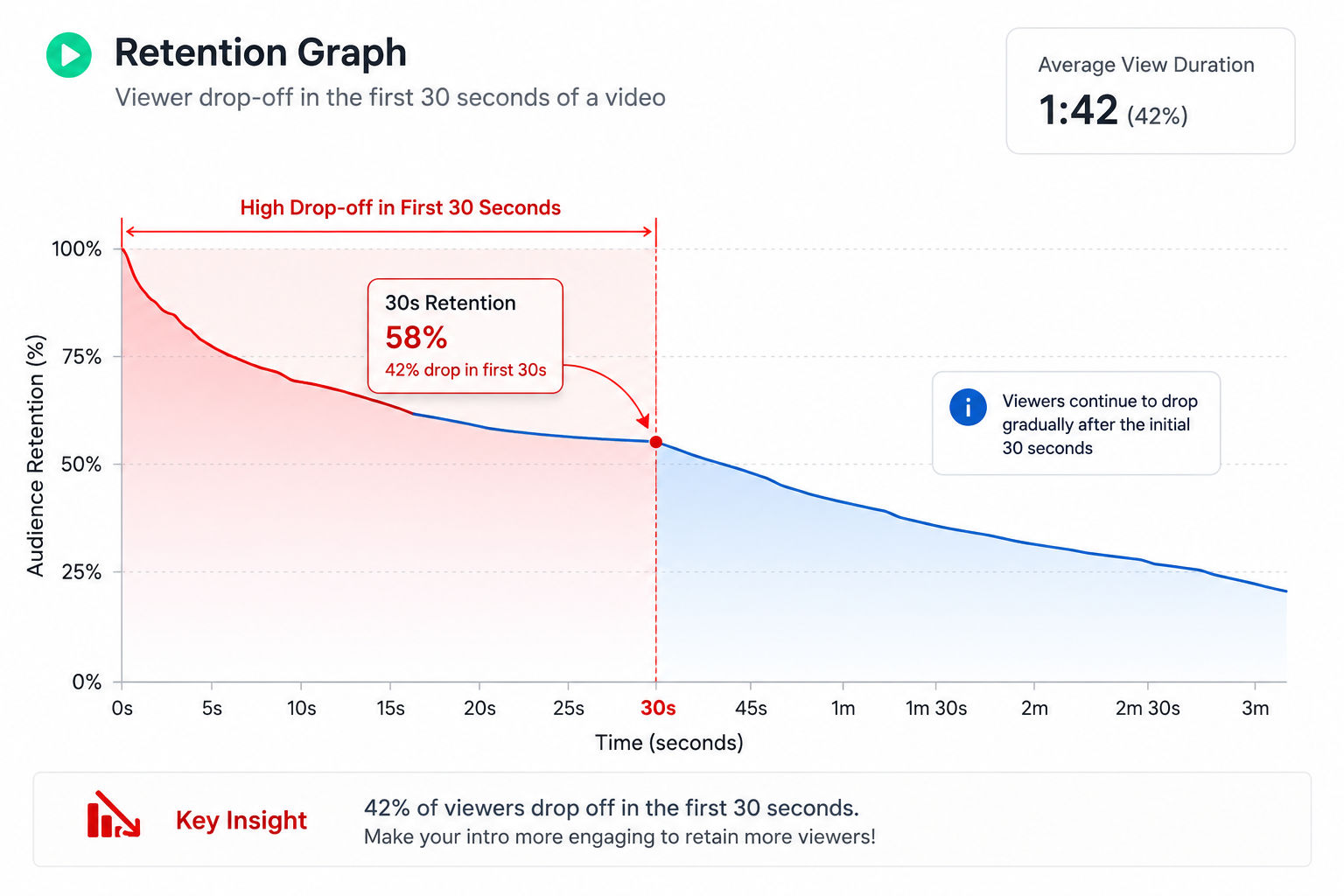
What makes viewers drop off in the first 30 seconds of a video? Usually, it’s not the production quality — it’s the opening. Most videos open with context or explanation, and viewers have already left before the “why” ever arrives.
If you’ve ever pulled up an analytics dashboard and watched your retention graph fall off a cliff right after the intro, you already know this feeling. You spent hours on the script, the shoot, the edit — and the graph doesn’t care. It just drops.
Here’s the good news: this isn’t a talent problem, and it isn’t a budget problem. It’s a structure problem. And structure can be copied, tested, and fixed.
In this piece, we’re going to break down the exact 7-step opening framework that consistently outperforms “intro-first” videos across YouTube and Instagram — the same pattern showing up again and again in the top-performing content across categories. Then we’ll show you the part most teams skip: how to find out which of these openers is already working for your specific category, before you shoot a single frame.
Let’s get into it.
Why the First 30 Seconds Carry the Whole Video
Here’s the uncomfortable truth: attention on video platforms isn’t earned through better lighting or a sharper thumbnail. It’s earned through tension — an emotional hook that makes someone want to know what happens next.
Platforms reward this behavior algorithmically. A video that holds viewers through the first 30 seconds tends to get pushed further, because the platform reads that early retention as a signal that the content is worth showing to more people. A video that loses viewers early sends the opposite signal — and it gets buried, no matter how good the rest of the content is.
So the first 30 seconds aren’t just an intro. They’re the gate. And most videos are opening the wrong door.
The 7-Step Hook Framework
This is the structure behind openings that consistently hold attention — broken down step by step, so you can apply it to your next script.
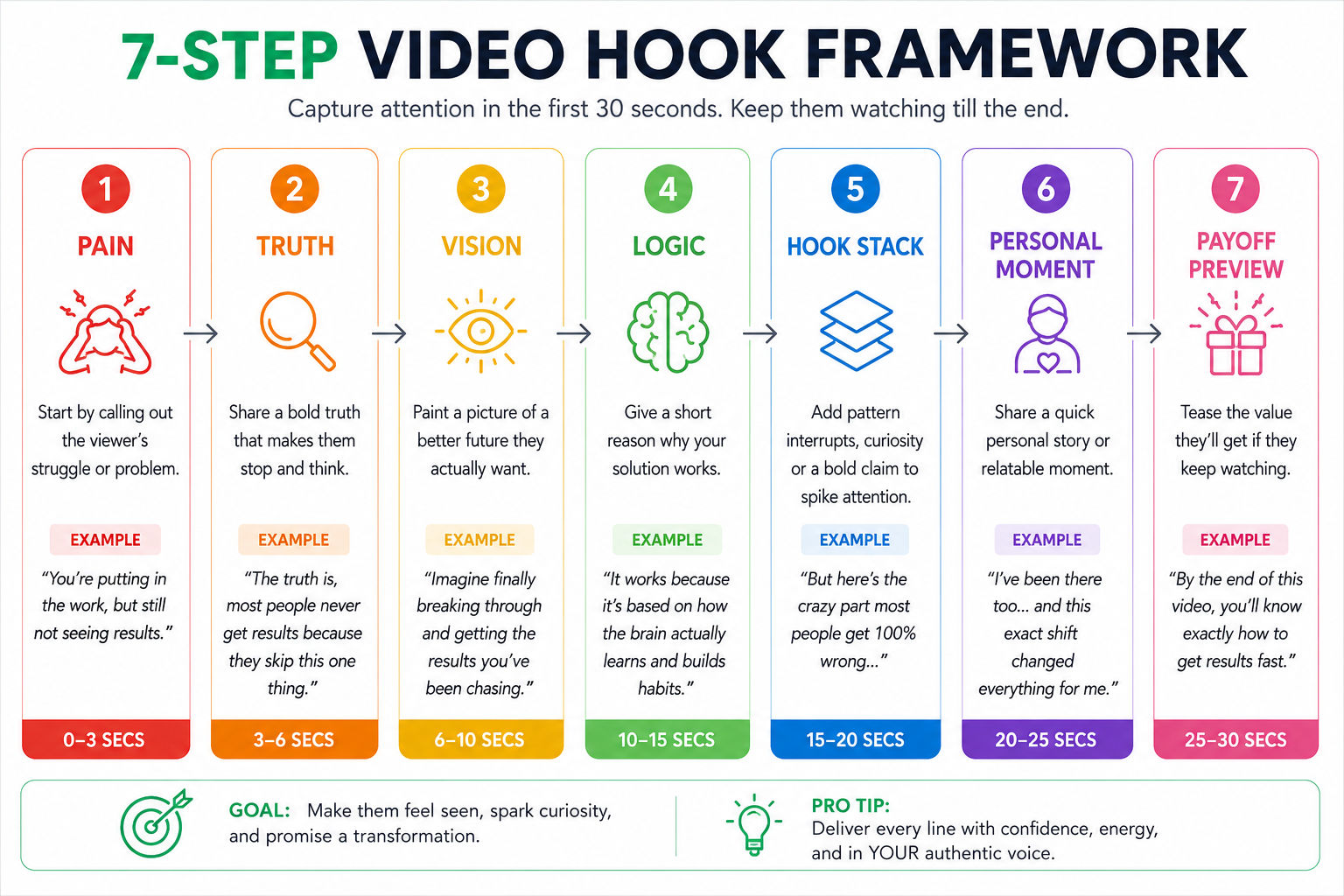
Step 1: Open With the Moment of Pain
Before you introduce your topic, name the frustration your viewer is already feeling. Not your frustration — theirs. Write down the exact sentence they’d say to a friend when they’re annoyed about this problem, and open with a version of that line, using “you” instead of “I” or “we.”
When someone feels recognized in the first five seconds, they lean in instead of scrolling past. You’ve earned the right to teach them something — but only after they feel understood.
Step 2: Land a Relatable Truth Line
This is the short, punchy line that captures what everyone in your category quietly already believes but rarely says out loud. Something in the spirit of “Let’s be honest…” or “Here’s the truth about…” — under seven words, mirroring the exact frustration you just named.
It works because it feels less like marketing and more like someone finally saying the thing out loud.
Step 3: Paint the Vision
People don’t follow information. They follow transformation. So the next line isn’t a feature — it’s a picture. What does it look like if this actually works? Write that as a single, vivid sentence your viewer can picture immediately.
This is the emotional hook. The next step is where you back it up with logic.
Step 4: Build the Logic Bridge
Now you explain why this is happening — tying the problem to a behavior or a pattern your audience will nod along to. This is the “here’s why this keeps happening” moment. It doesn’t need heavy data; it needs one clear, credible reason that makes the pain make sense.
Step 5: Stack the Hook
This is where the first four steps combine into a repeatable three-line formula:
- Pain — “You ever notice how…?”
- Truth — “It’s not actually X, it’s Y.”
- Promise — “By the end of this, you’ll…”
This three-layer stack is the backbone behind most high-retention openings, regardless of category or platform. It’s simple enough to write in under a minute once you know the shape.
Step 6: Make It Personal
Numbers and frameworks build credibility. A brief personal moment builds trust. One line referencing your own version of this struggle, followed by a “but then” pivot, does more for connection than a full paragraph of credentials.
Step 7: Preview the Payoff Early
Before diving into the full breakdown, tease the outcome. A quick visual cue, a graph, a before-and-after glance — anything that shows the payoff is real and coming. This single move has an outsized effect on how long people stay watching, because it gives them a concrete reason to keep going instead of a vague promise.
Here’s Where Most Teams Get Stuck
Knowing the framework is one thing. Knowing which version of it is already winning in your category is another problem entirely.
Because here’s the catch: “Moment of Pain” for a BFSI brand looks nothing like “Moment of Pain” for a D2C skincare brand. The hook stack that works for a fintech explainer isn’t the one working for a beauty creator. Copying a generic framework gets you generic results. What actually moves the needle is knowing exactly which pain lines, truth lines, and pacing choices are already outperforming everything else — for your competitors, in your category, this month.
That’s the part most teams either guess at or skip entirely, because it means manually watching dozens of competitor videos, timestamping their openings, and reverse-engineering what’s working. It’s not a lack of effort — it’s a lack of time.
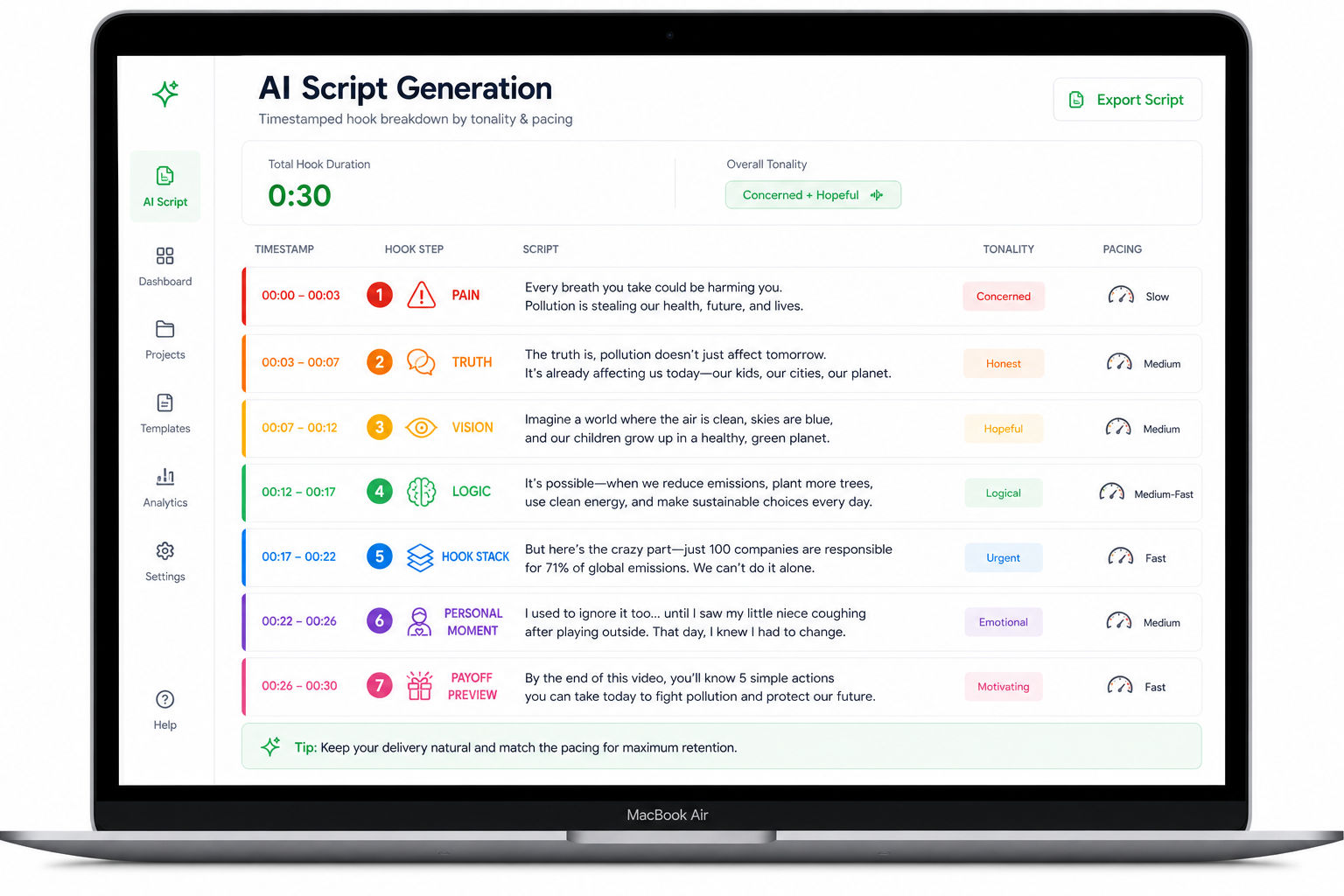
This is exactly the gap Lumetrics’ AI Script Generation module was built to close. Instead of guessing at a hook, the module pulls the top-performing videos in your category, breaks them down by Hooks, Tonality, Pacing, and Visual structure, and generates a timestamped script grounded in what’s already proven to work — refined further against your own brand guidelines and audience sentiment. It’s the difference between applying a framework in theory and applying the exact version of it that’s currently winning in your space.
Putting It Together
The first 30 seconds of your next video don’t have to be a guess. Run through the seven steps — pain, truth, vision, logic, hook stack, personal moment, payoff preview — and you’ll already be ahead of most of what’s competing for the same attention.
But if you want to skip the manual research and know precisely what’s working in your category right now, that’s exactly what Lumetrics is built for.
See your brand’s video performance inside Lumetrics — live, in 30 minutes. We’ll plug in your brand and three competitors so you can see exactly where you rank, how your audience feels, and what to script next.
Leave a Reply