
The Instagram Growth Strategy That Actually Works in 2026: Win Strangers, Earn Trust, Then Sell
Synopsis: This Instagram growth strategy shows how to reach people who do not follow you yet, turn profile visits into interest, and build trust that supports a sale. Learn how Instagram recommendations work, which signals to watch, how to make your bio and content clearer to strangers, and how to turn real conversations into a repeatable plan.
You are posting Reels, carousels, product drops and behind-the-scenes clips. The effort is there. The growth is not. Views stall, followers trickle in and direct messages from people ready to buy rarely arrive.
It is tempting to blame the algorithm or chase another posting hack. Often the simpler issue is that your content assumes people already know you. New viewers do not. They need a reason to stop, a reason to trust what they see and a clear next step.
The strategy in one line: win attention from strangers, earn trust with useful and human content, then make action easy. This is not a guarantee of virality. It is a practical way to make your Instagram presence easier to discover, understand and choose.

Why the old Instagram playbook feels broken
A lot of advice still sounds like this: grow followers, post every day, use trending audio, add hashtags and sales will follow. Those tactics can sometimes help. None is a complete strategy.
Instagram does not use one universal algorithm. Feed, Stories, Explore, Reels and Search are ranked in different ways because people use each surface differently. Feed can include posts from accounts a person follows as well as recommendations; Explore and Reels are discovery spaces. Instagram describes many signals and predictions, not one fixed ranking formula.[2]
A post can reach existing followers in one context and be recommended to non-followers in another. A tactic that maintains a relationship with current followers may not be the same tactic that helps new people discover you.
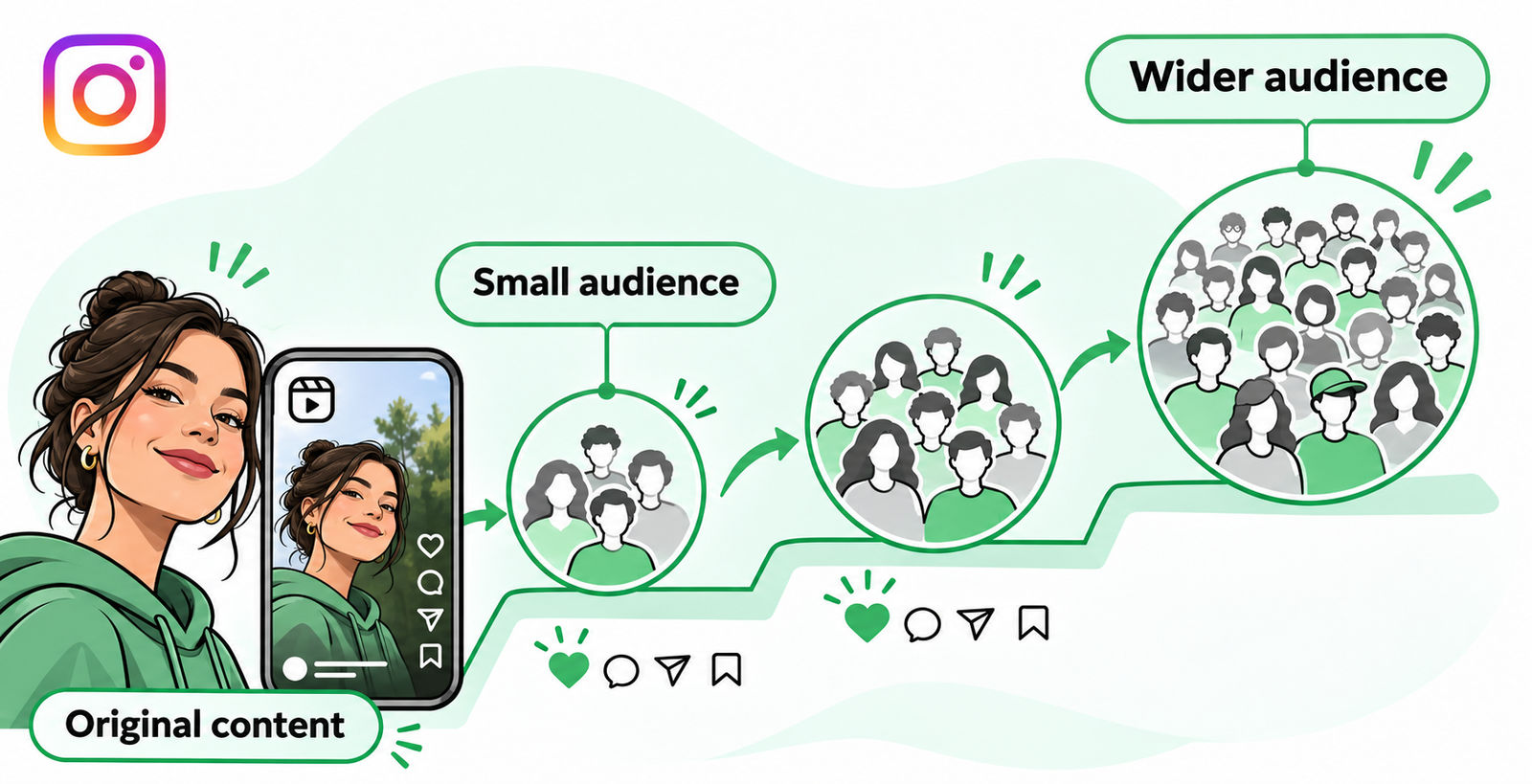
Instagram’s creator guidance says eligible Reels can be shown to a small audience of people who may enjoy them, including non-followers. If they respond well, some Reels may reach wider audiences in stages. This describes a recommendation approach; it does not promise that every post receives an identical test group or that strong engagement guarantees virality.[1][5]
Follower count can provide social proof, but it is not a distribution engine by itself. Your content still has to connect with the person seeing it, in the context where it appears.
What to measure: signals, not folklore
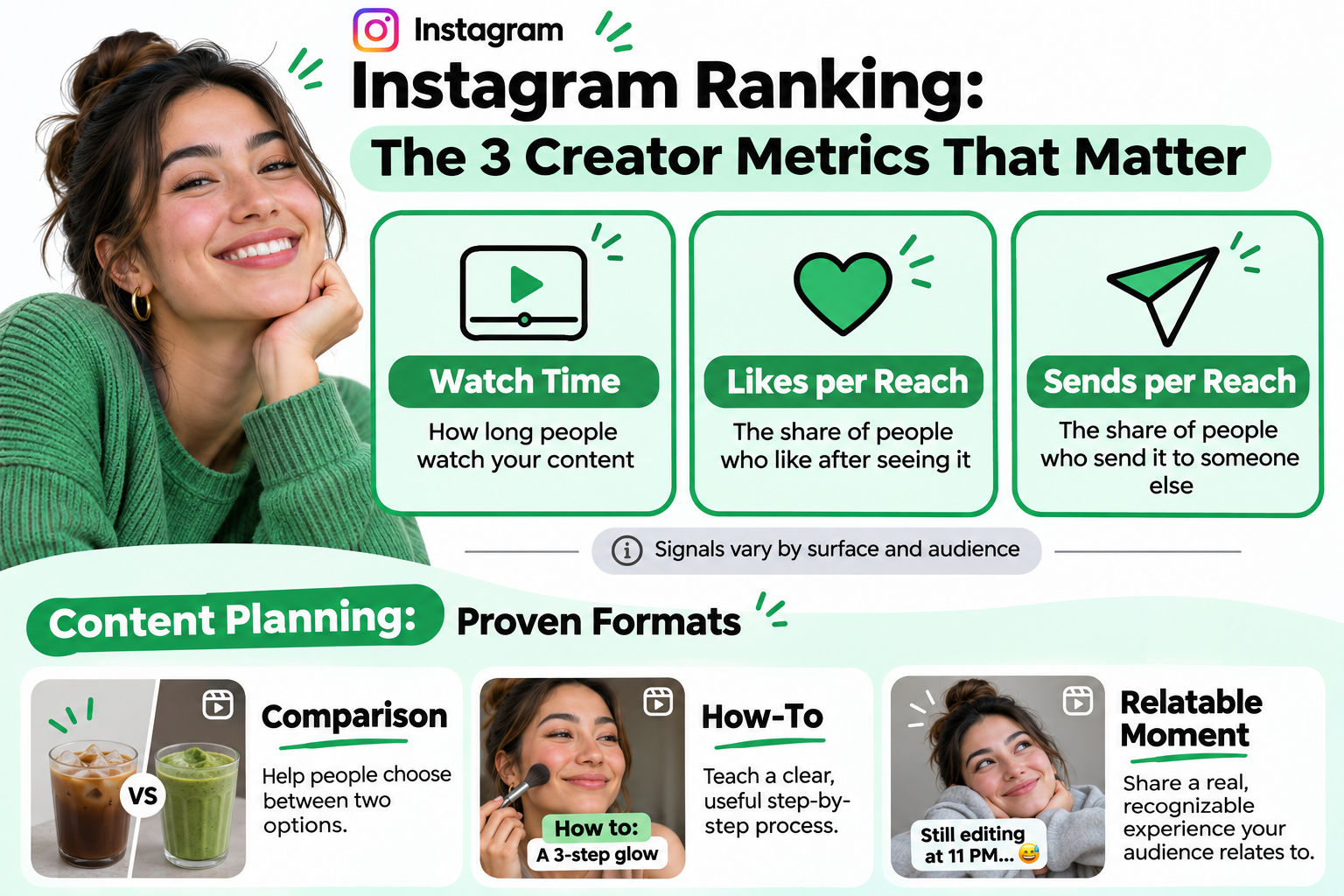
Instagram head Adam Mosseri has identified watch time, likes per reach and sends per reach as important ranking signals, while noting their relative weight varies by surface and audience.[1] That is more useful than treating every like, save or follower as equally important everywhere.
Watch time: did the opening earn the next second?
Watch time and retention help you see whether viewers stayed. A strong opening makes the subject clear quickly. It does not need a loud visual trick. It needs a promise, tension or demonstration that makes the next few seconds worth watching.
Show the result before the explanation, compare two options or name a familiar problem. Then deliver the payoff. If viewers leave early, inspect the first seconds and the gap between the promise and the answer. A longer Reel is not automatically better; use the length needed to make the point well.
Likes per reach: did it resonate?
Likes are a quick positive response. Instagram has said likes can matter more for connected reach—people who already follow you—than for discovery among non-followers.[1] Use likes per reach to compare posts with similar audiences and formats. It is a directional metric, not a universal benchmark.
Sends per reach: was it worth passing along?
A send is a private recommendation: someone decided another person should see the content. Instagram has said sends can matter more for unconnected reach, where the goal is reaching people who do not follow you.[1] Content gets sent when it solves a recognizable problem, explains something clearly or captures a feeling worth sharing.
Saves, comments, profile visits and follows are still useful as business outcomes and audience clues. The point is not to ignore them. It is to avoid presenting them as the official top three ranking signals when Instagram names other priorities. Track several measures and ask what each one says about the path from impression to action.
Views alone are not the finish line. A Reel with fewer views may attract more of the right people, generate profile visits and lead to qualified questions. Compare reach, retention, profile actions and conversations—not just raw plays.
Shift 1: Make your bio answer the visitor’s question
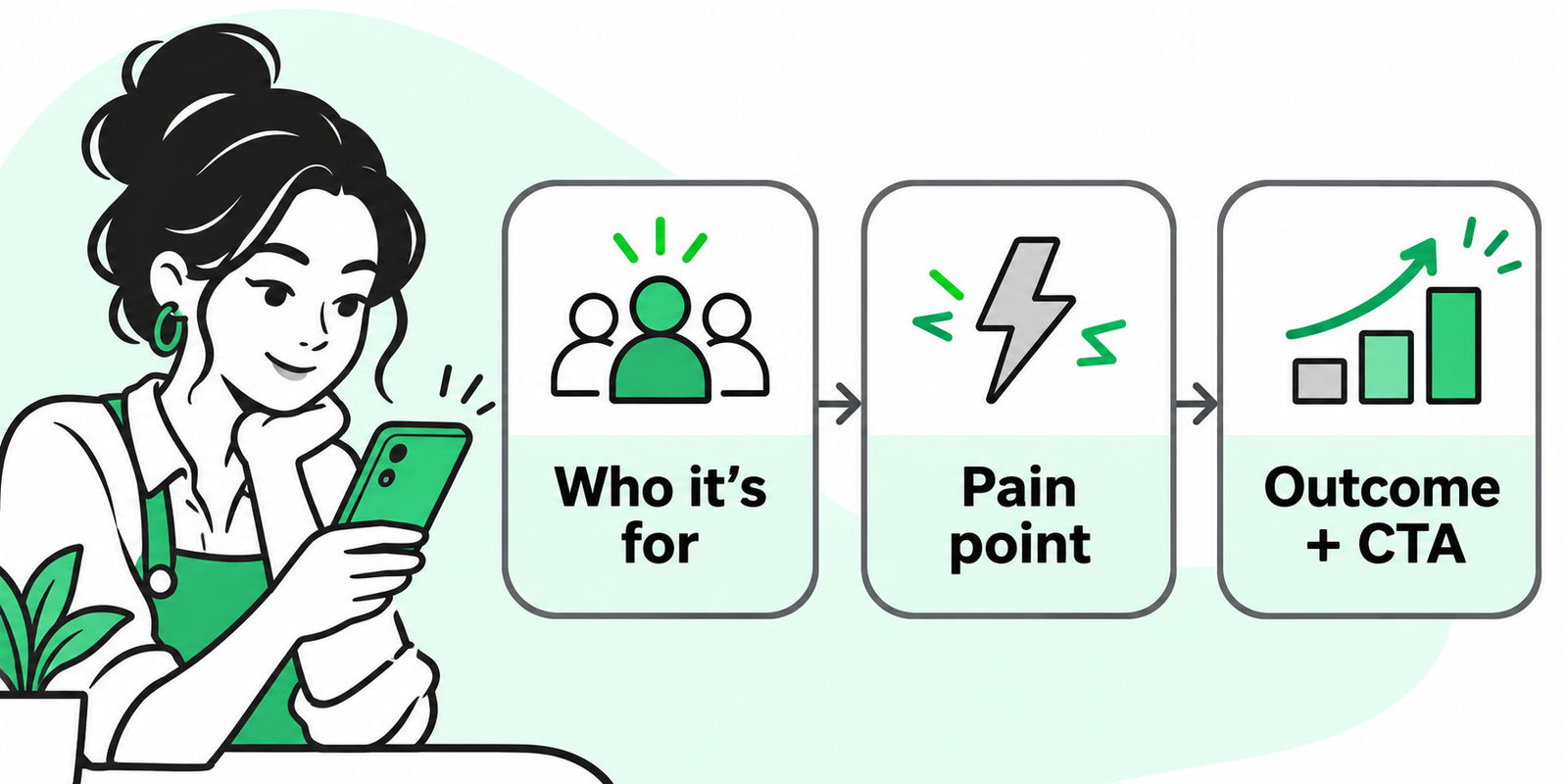
Someone watches a Reel and taps your profile. In a few seconds, they ask: What is this account? Is it for someone like me? What should I do next? Your bio should answer quickly. It is not a résumé or a place for vague adjectives. Treat it as a small landing page.
A simple bio formula
Who it is for + the specific problem or desire + the outcome you help with + one next step.
Instead of a vague line like “Quality pieces for everyday life,” a clothing brand could say: “Everyday layers for people tired of tees that lose shape. See how each fit wears after a wash.” A consultant might say: “Helping small ecommerce teams turn repeat questions into useful customer education. Get the free planning checklist.” Use your own customer language, not these examples verbatim.
Replace generic claims with a clear audience, recognizable need and relevant action. Keep contact details in Instagram’s contact buttons where possible. Make the link destination match the promise in the bio. If you offer a fit guide, do not send people to a confusing homepage.
Review the display name, profile image, pinned posts, highlights and link page as one experience. A new visitor should identify what you offer, see evidence of how it works and find a sensible next step. For a product brand, pin a demonstration, buying guide and answer to a common objection. For a service business, pin who you help, what a first engagement looks like and what a good fit means.
Shift 2: Make posts for strangers, not only followers
Existing followers know your products, people and history. A stranger does not. Internal announcements often make poor discovery content because “new drop is here” matters most to someone already waiting for it.
Lead with a question, frustration or goal your customer already recognizes. Then put your product, service or perspective into that context. Instead of “Our new hoodie just landed,” try “What should you check before buying a hoodie you plan to wear every week?” Instead of “Meet our founder,” explain the customer problem that changed how you design a product. Instead of “We are excited about a new service,” show how to turn a repeated customer question into a useful answer.
These are not guaranteed winning hooks. They are clearer starting points because they put the audience’s question ahead of the brand’s announcement. The content still has to deliver on its opening promise.
Research the words customers use
Talk to customers. Read product reviews, support tickets and public comments in your category. Notice repeated questions, objections and phrases. Keep a simple research sheet: the question, who asks it, the context and a possible content answer. Use public patterns, not identifiable personal details from someone else’s comment.
For each idea, ask: Would someone who has never heard of us understand the first frame? Does the post answer one useful question? Is the payoff clear? Would a person send it to a friend with the same problem? If not, sharpen the angle before filming.
Use the first seconds honestly
A hook is a promise. If the first line promises three ways to make a shirt last longer, deliver three real ideas. Avoid bait-and-switch intros, misleading captions or suspense that never resolves. Instagram’s creator guidance encourages authentic engagement and warns against clickbait and engagement bait in recommendation contexts.[3]
High-resolution uploads, clear audio, readable on-screen text and a sensible pace remove friction. Instagram recommends making the first seconds engaging, but that does not mean every Reel needs fast cuts. Choose a format that makes the idea easy to understand: demonstration, comparison, tutorial, story or answer to a common question.[3]
Shift 3: Build for a response, not a posting quota
There is no universal calendar that fits every account. Instagram’s creator FAQ says frequency is one factor among many. It notes that creators with the greatest net follower-growth rates post 10 or more Reels per month on average and recommends testing a cadence that fits your goals and audience.[3] That is an observation, not a quota or a promise that posting ten times will grow your account.
Start with a schedule you can maintain without lowering the usefulness of each post. A small business might publish two Reels and one carousel a week, then use Stories for updates and conversation. Another business may need a different rhythm. Track outcomes for several weeks before changing multiple variables at once.
Choose the intended response before creating. To earn watch time, show a process or comparison with a clear payoff. To earn sends, make a checklist, correct a misconception or capture a relatable moment. To earn likes from current followers, share a distinct point of view or community moment. To encourage profile actions, lead to a pinned post or service explanation that completes the story. These are creative hypotheses, not mechanical ranking tricks.
Prefer original work and purposeful reuse
Instagram says it wants to recommend original content and help creators reach new audiences. It has described replacing identical reposts with the original in recommendations, and its guidance encourages material additions when using third-party work.[4][5] A recycled clip with a new border or watermark is not a reliable growth plan. Add real value: original commentary, a new demonstration, meaningful editing or a different lesson.
Revisit a strong topic, but do not assume an unchanged Reel reposted after two weeks will receive a boost. Public guidance emphasizes originality, eligibility and relevance, not a guaranteed repost boost. Keep the insight and create a new version: answer a follow-up question, update the demonstration, change the format or make the explanation more useful.
The trust layer: from reach to relationships
Attention is the opening, not the whole sale. People need evidence that you understand their situation and can help. That comes from useful communication—not from pretending every post is a personal confession or sending unsolicited pitches.
Use this H.U.M.A.N. sequence as a working checklist:
- Hook: begin with an audience problem, desire or question. Be specific enough for the right person to recognize it.
- Understand: listen to replies, customer interviews and questions. Note what people want and where they get stuck.
- Message: explain your point of view in your own voice. Add context, examples and trade-offs, not just recycled tips.
- Amplify: invite a real response. Ask questions when you genuinely want the answers. Reply to thoughtful comments and share community contributions with permission.
- Nurture: continue the conversation when someone asks for help. Offer a useful resource or next step. Ask before turning it into a sales conversation, and respect a no.
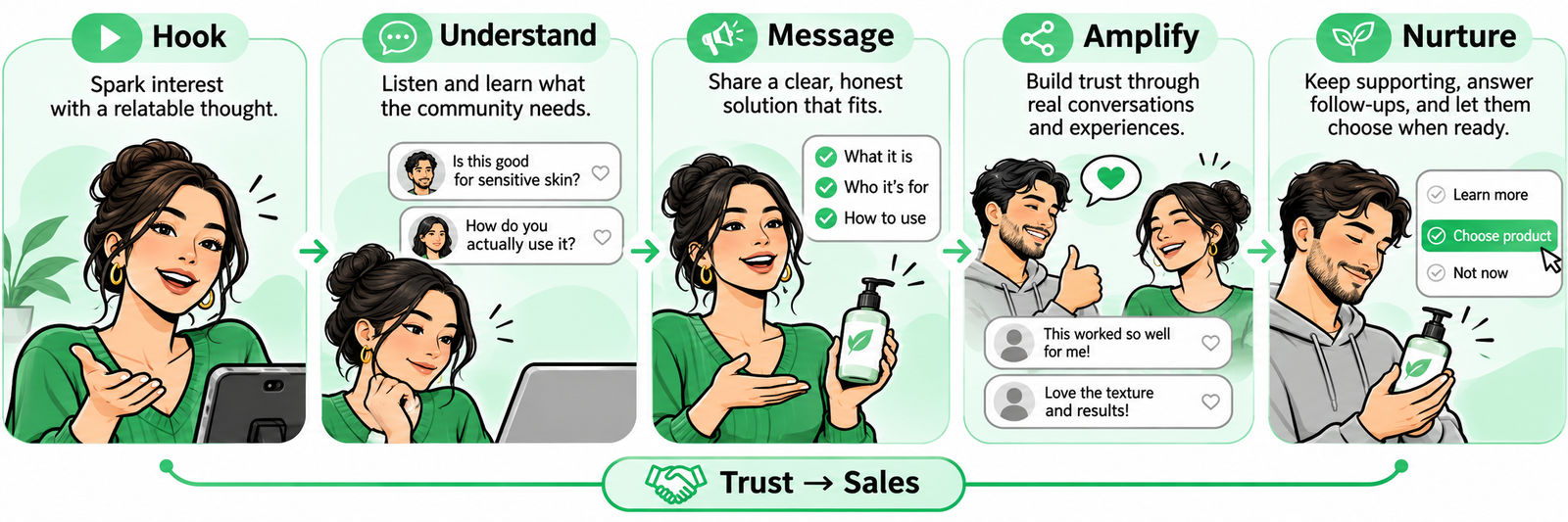
This framework is a practice, not an algorithm hack. A genuine exchange may not produce an immediate sale. It can help you understand your audience, improve content and make future offers more relevant. Avoid fake comments, mass-DM scripts and engagement bait. Short-term activity is not the same as earned trust.
Turn Instagram insights into decisions
Use a weekly review that is small enough to keep doing. For each post, note its format, topic, opening, reach, watch-time or retention measure available in Insights, likes per reach, sends per reach, profile activity and qualified conversations. Look at several posts together; one unusually large or small result is not a strategy.
Ask four questions. Which topics held attention? Which were sent to someone else? Which made a visitor take a useful profile action? Which attracted the kind of person your business can serve? The answers may point in different directions. That tells you where discovery works and where your profile or offer needs improvement.
A tutorial could earn strong watch time but few profile visits. The lesson may be engaging, while the bridge to your next step is weak or unnecessary. A product comparison may earn sends but few purchases because people need sizing, price or availability information. Treat metrics as diagnostic clues. Do not force every post to sell directly.
Keep a content log and change one variable at a time: opening, format, length, explanation or call to action. If you change everything at once, you will not know what helped. Use business outcomes—qualified enquiries, product-page sessions, add-to-carts or repeat purchases—alongside platform measures. Tracking links can help, but not every Instagram-influenced purchase will be attributed perfectly.
Your 30-day Instagram growth plan
Week 1: clarify the promise
Rewrite the bio using audience, problem and outcome. Choose one action for the link. Review the profile image, pinned posts and highlights. Ask current customers what made them follow and what they still find confusing. Write down their exact words.
Week 2: publish for discovery
Create original Reels that answer real customer questions. Test different openings while keeping the core topic similar. Make the first frame legible and the payoff honest. Add a carousel or static post if it explains the subject better than video. Give each piece one primary purpose.
Week 3: improve the trust path
Review comments and DMs. Answer questions with care. Turn recurring questions into useful follow-up content. Pin the post that best explains your offer. If someone asks about buying, make the next step clear without pressure.
Week 4: review and refine
Compare reach, retention, likes per reach and sends per reach, then check profile actions and business outcomes. Find one pattern worth repeating and one weak point to improve. Create a new version of a useful topic rather than mechanically re-uploading a duplicate. Keep a record so next month starts with learning, not guesswork.
Instagram growth strategy checklist
- Your bio makes the audience, problem and next step obvious.
- Your opening makes sense to someone who has never heard of your brand.
- Your post delivers on its hook and offers useful or entertaining value.
- You publish original work or materially add a distinct perspective to source material.
- You measure watch time, likes per reach and sends per reach, alongside business outcomes.
- You use a sustainable cadence and test it rather than treating a number as a guarantee.
- You reply to real questions and make sales conversations permission-based.
- You check Account Status if recommendations or distribution change unexpectedly.
The bottom line
A workable Instagram growth strategy is not “post more and hope.” Make your promise clear, create original content a stranger can understand, earn attention with a real payoff, and continue with useful human communication. Watch time, likes per reach and sends per reach help explain how content is responding, but no metric guarantees reach or revenue.
Build for people first. Use Instagram Insights to learn what is happening. Connect platform activity to the outcome that matters—relevant visits, conversations, enquiries or sales. That is how you move from a busy feed to a growth process you can improve.
Frequently asked questions
How does the Instagram algorithm work in 2026?
Instagram uses different ranking systems for Feed, Stories, Explore and Reels. Eligible Reels may be shown to a small audience of interested non-followers and can reach wider groups depending on response. Signals include watch time, retention, shares, likes and audience interests. No single formula guarantees reach.[1][2]
What are the most important Instagram ranking signals?
Instagram head Adam Mosseri has named watch time, likes per reach and sends per reach among the top signals, with relative importance varying by surface and audience. Saves, comments and profile actions remain useful analytics, but are not the same as that specific top three.[1]
How often should a business post on Instagram to grow?
There is no universal cadence. Instagram reports that its fastest-growing creators average at least 10 Reels a month, but that is an observed average, not a minimum or guarantee. Choose a sustainable schedule and compare results over time.[3]
What should I write in an Instagram bio for business?
State who you help, the problem or desire you address, the outcome you offer and one clear next action. Use plain language and make sure the link delivers what the bio promises.
Should I repost an Instagram Reel that underperformed?
Revisit the idea if it is useful, but do not expect an unchanged duplicate to receive a boost. Instagram favors original content and meaningful additions. Make a new version with a clearer opening, updated information or a different format.[4][5]
Sources
- [1] Instagram for Creators: Helping creators of all sizes break through
- [2] Instagram: Ranking Explained
- [3] Instagram for Creators: FAQ
- [4] Instagram for Creators: Original Content Guidelines
- [5] Instagram for Creators: Helping Creators Find New Audiences
Updated and fact-checked November 25, 2026. Instagram features and recommendations change; use your account’s current Insights and Account Status for account-specific guidance.
Leave a Reply