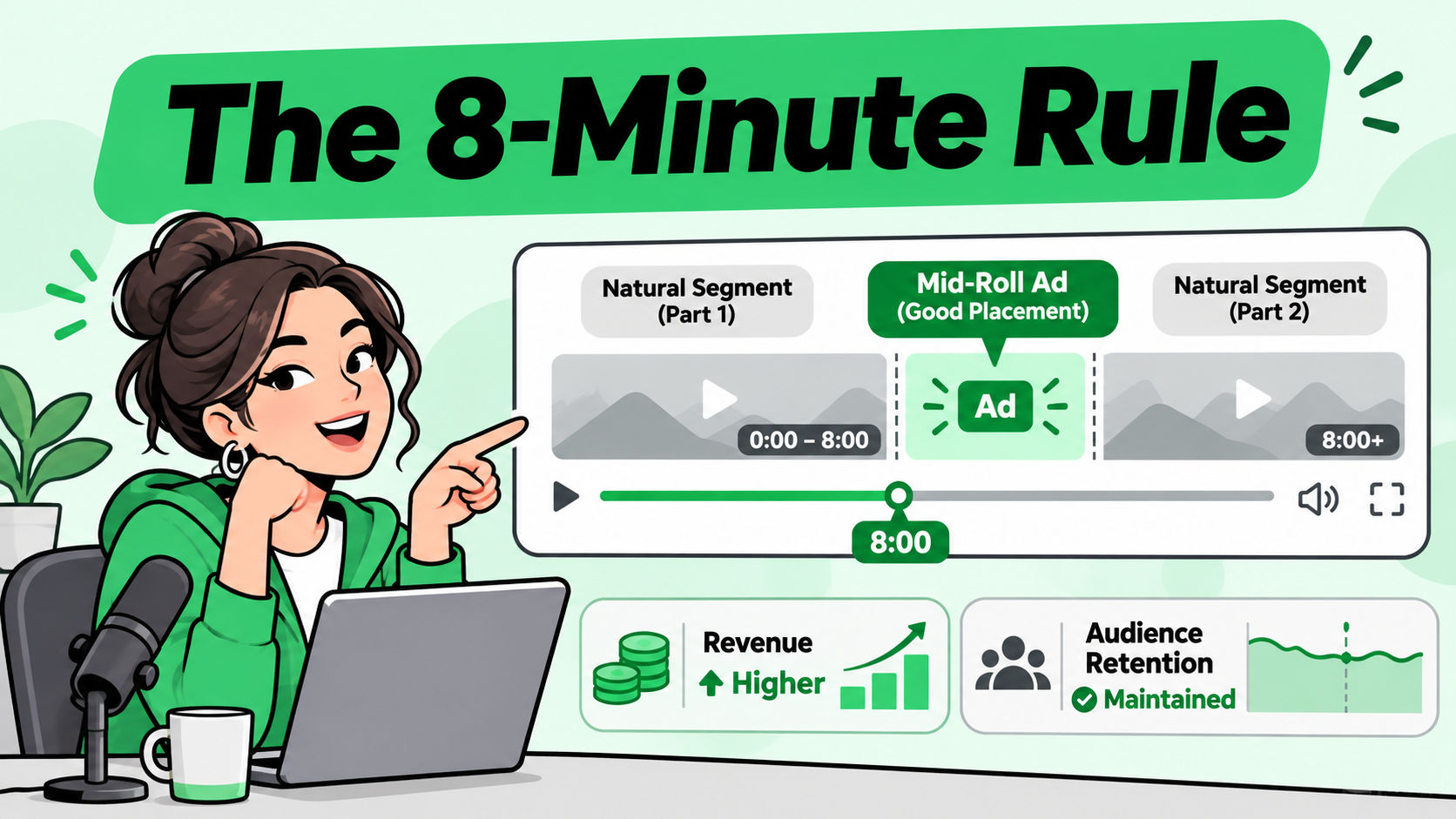
Synopsis: This guide explains when the 8-minute threshold unlocks YouTube mid-roll ads, how to choose placements, and how to weigh monetization against viewer retention without padding a video.
You uploaded a video. It crossed 8 minutes. You flipped on mid-roll ads expecting a nice little bump in revenue.
Instead, your average view duration tanked, your RPM barely moved, and now you’re wondering if the 8 minute rule is even worth bothering with — or if you just broke your own video trying to chase it.
Here’s the thing. The 8-minute rule on YouTube isn’t a myth, and it isn’t optional trivia for YouTube nerds. It’s the single length threshold that decides whether you’re allowed to run mid-roll ads at all. Get it right, and it can meaningfully increase what a video earns. Get it wrong — pad a video to 8:01 just to unlock ads, or cram in six mid-rolls because you can — and you’ll watch viewers bail mid-scene while your RPM barely budges.
So let’s actually break this down: what the rule says, where it came from, how many ad breaks you should run, and how to use it without wrecking retention.
What Is the YouTube 8-Minute Rule, Exactly?
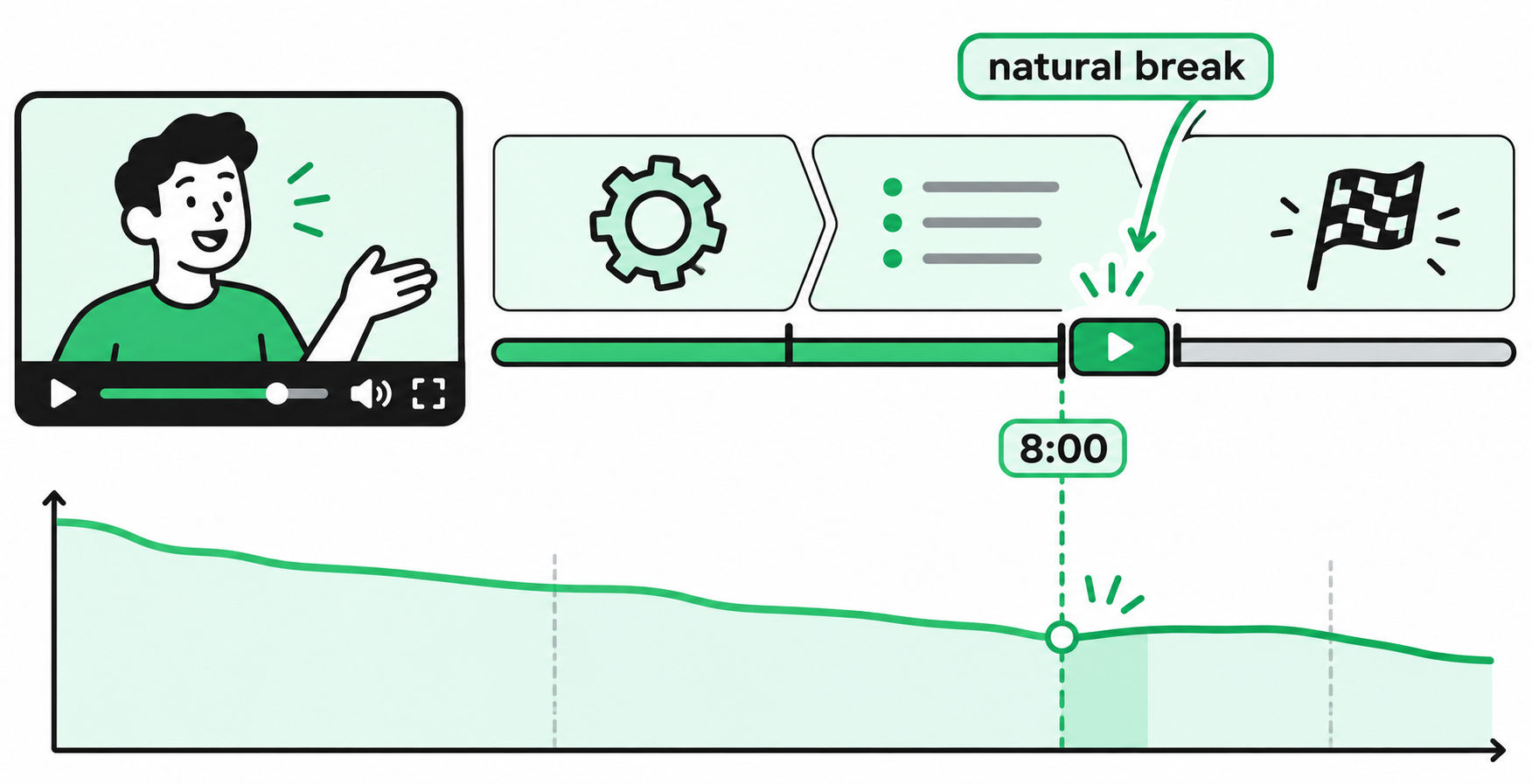
The 8-minute rule is simple on paper: a video needs a total runtime of at least 8 minutes before YouTube will let you place mid-roll ads inside it.
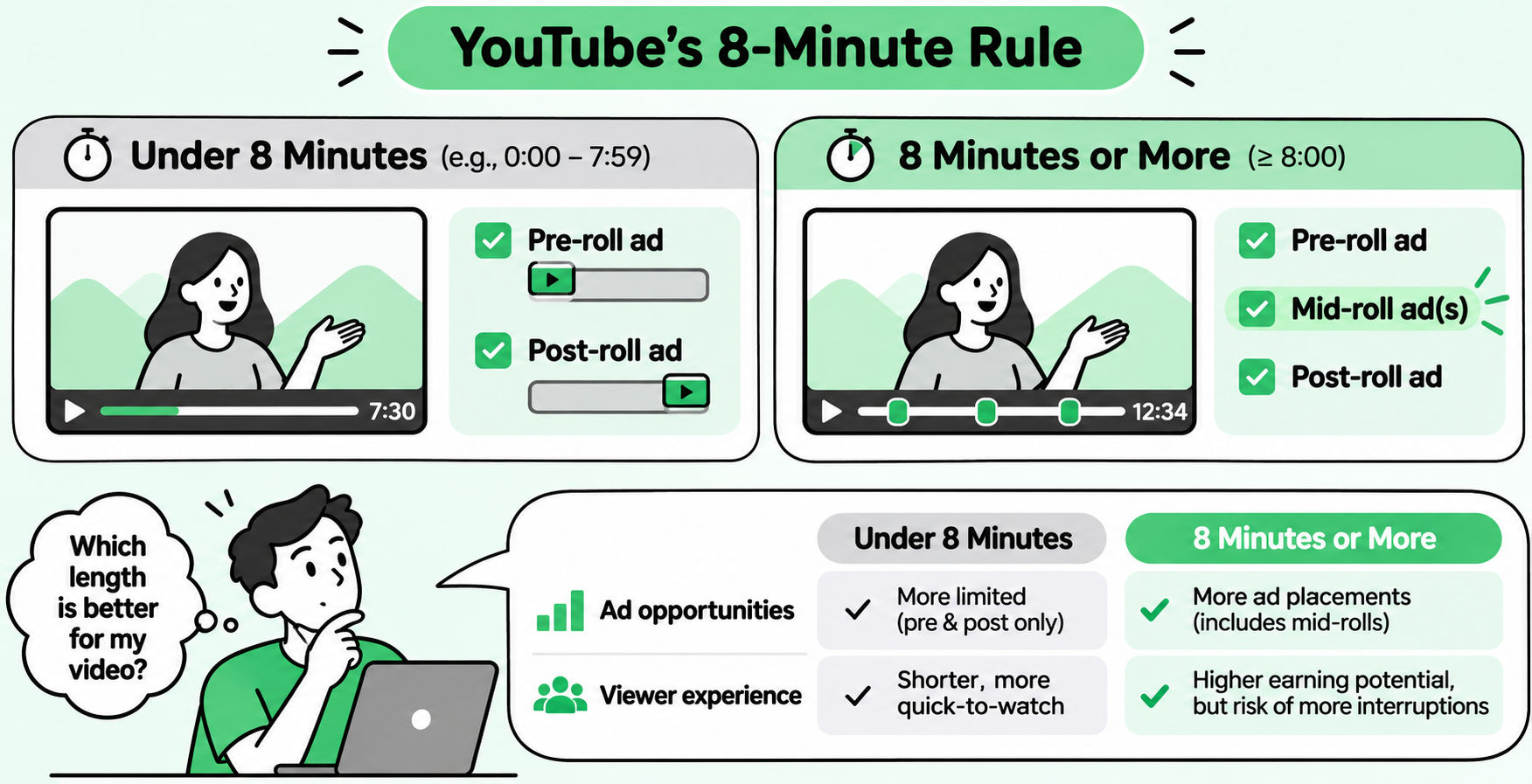
Mid-roll ads are the commercial breaks that interrupt a video while it’s playing — as opposed to pre-roll (before the video starts) or post-roll (after it ends). Under 8 minutes, you can still run pre-roll, post-roll, and overlay ads. You just can’t interrupt the video itself.
Cross the 8-minute line, and a new option unlocks in YouTube Studio: mid-roll ad placement, either automatic or manual. That’s the whole rule. One number, one gate, one feature that opens up on the other side of it.
It sounds almost too simple to have a nickname. But here’s why creators talk about it like it’s a strategy unto itself: that single number — 8:00 — has quietly shaped how long a huge share of YouTube’s long-form content is. Plenty of videos that could easily say what they need to say in six minutes get stretched to 8:15 purely so mid-rolls become available. More on whether that’s actually a good trade later.
One thing worth flagging up front: this rule doesn’t apply to Shorts. Shorts monetize through a completely separate revenue-sharing pool, and mid-roll ads aren’t part of that mechanism at all. The 8-minute rule is strictly a long-form, horizontal-video thing.
Where the 8-Minute Number Came From
You might be wondering why 8 minutes specifically — why not 5, why not 10?
Actually, it used to be 10. Until July 2020, a video had to run longer than 10 minutes before mid-roll ads became available. That July, YouTube emailed creators to announce it was lowering the threshold to 8 minutes, and — this is the part people forget — it also switched mid-roll ads to opt-in-by-default for every eligible video going forward.
YouTube’s stated reasoning was straightforward: more eligible videos means more monetization opportunity for creators, especially channels that had been deliberately keeping videos just under the old 10-minute line because going longer didn’t feel worth the hassle for only slightly more inventory. Lowering the bar to 8 minutes opened up mid-rolls to a meaningfully larger slice of the platform’s long-form catalog overnight.
The “opt-in by default” part had real teeth, too. Creators who’d previously turned mid-rolls off got opted back in automatically, with a deadline in late July 2020 to opt back out if they didn’t want them — a detail that mattered a lot to channels making meditation content, ASMR, or anything else where a sudden ad interruption would wreck the experience.
So the 8-minute rule isn’t some ancient, unchangeable law of YouTube physics. It’s a policy decision from 2020, and the underlying logic — expand monetization access without demanding dramatically longer videos — is worth remembering, because it tells you what YouTube actually optimizes for: more inventory, not necessarily more interruptions per video.
What You Can (and Can’t) Do Under 8 Minutes
Let’s be clear about what’s actually gated by this rule, because a lot of creators overestimate how much it’s blocking them.
Below 8 minutes, you still have real monetization options:
- Pre-roll ads — the skippable or non-skippable ad before your video starts.
- Post-roll ads — the ad that plays after your video ends, assuming the viewer’s still around.
- Overlay/display ads — the banner-style ad that sits in the corner of the player on desktop.
None of those require hitting 8 minutes. Mid-rolls are the only ad format that’s locked behind the threshold. So a 4-minute video isn’t “unmonetized” — it’s just working with a smaller toolbox.
What changes at 8 minutes is that YouTube Studio lights up the mid-roll option under your video’s monetization settings. You’ll see a choice between automatic placement (YouTube decides where the breaks go) and manual placement (you decide). We’ll get to which one you should actually pick in a second.
And to repeat the point from earlier because it trips people up constantly: none of this applies to Shorts. If your content strategy leans heavily on short-form, the 8-minute rule simply isn’t the lever you’re pulling for revenue — Shorts monetization works through a different pool entirely.
How Many Mid-Roll Ads Should You Actually Use?
So you’ve crossed 8 minutes. Great — now how many ad breaks is actually sensible?
There’s no hard cap YouTube enforces beyond spacing logic, but there’s a widely used, retention-sane guideline worth following rather than reinventing:
- 8–15 minutes: 1–2 mid-rolls
- 15–20 minutes: 2–3 mid-rolls
- 20–30 minutes: 3–5 mid-rolls
- 30+ minutes: 5 or more, spaced roughly every 8–10 minutes
Notice the pattern: it’s not “more minutes equals proportionally more ads crammed in.” It’s closer to one mid-roll per 8–10 minutes of content, scaling up gradually. The reason is simple economics, not platform generosity — cram in too many breaks and your average view duration collapses, and a collapsed view duration quietly drags down the very RPM you were trying to boost in the first place.
Here’s the kicker most people miss: RPM and ad count aren’t the same lever. You can run fewer, better-placed mid-rolls and out-earn a video that’s stuffed with interruptions, because YouTube’s ad auction values an engaged, watching audience more than it values raw ad-slot volume. An ad nobody sticks around for isn’t worth much to an advertiser, and YouTube’s systems account for that.
Manual vs. Automatic Placement: Which Should You Pick?
YouTube gives you two ways to handle mid-rolls once you’re eligible, and they’re not equally good.
Automatic placement lets YouTube’s system choose ad break points using signals like detected pauses, scene changes, and natural pacing shifts. It takes zero setup. You flip it on and YouTube handles the rest. That’s exactly why so many channels default to it — it’s the path of least resistance.
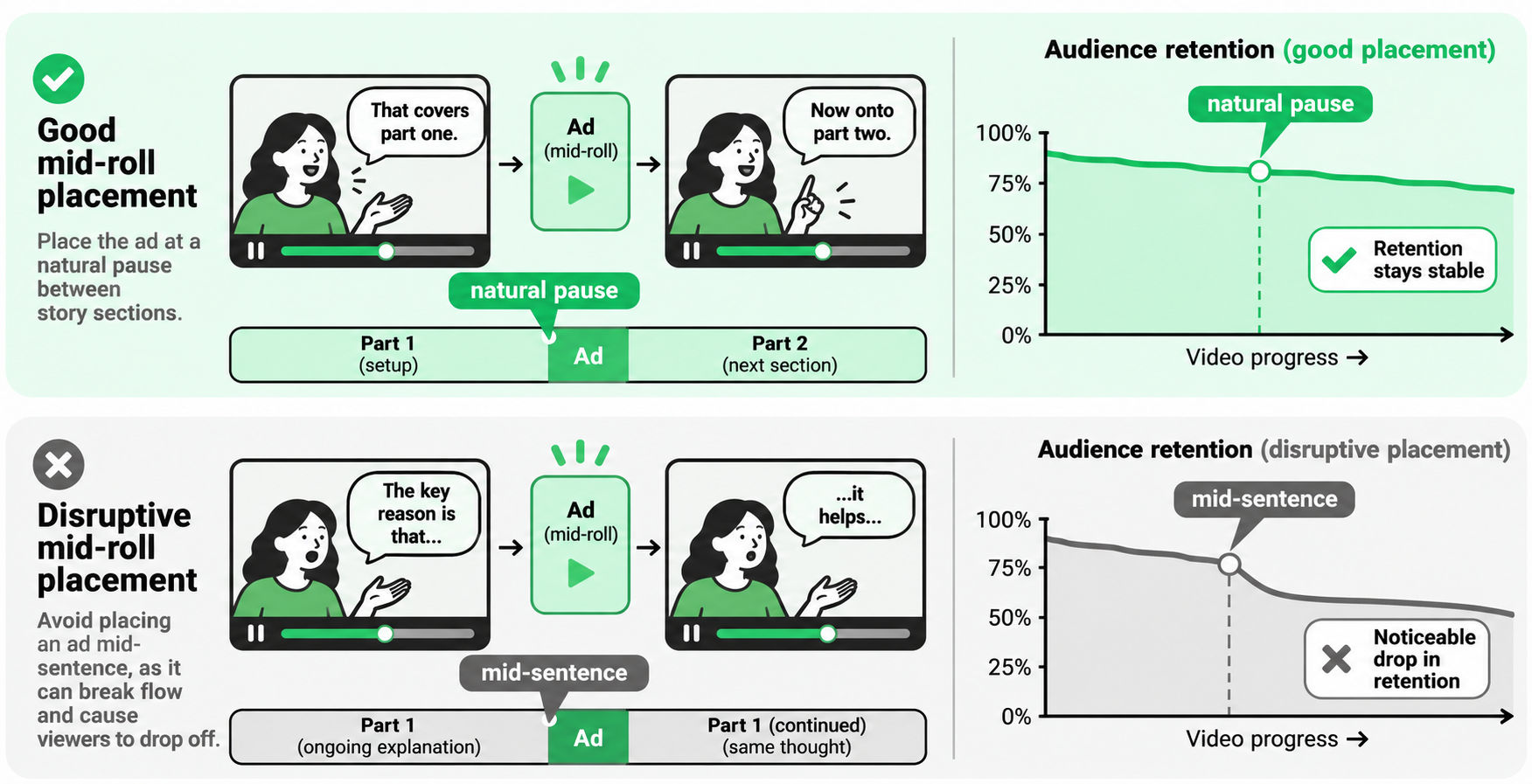
Manual placement means you choose every break point yourself, ideally at moments that are already natural pauses in your content: after you’ve resolved a thought, between segments, right after a punchline lands rather than mid-sentence before a punchline.
The difference in practice is bigger than it sounds. Automatic placement occasionally drops an ad break at an objectively bad moment — mid-explanation, mid-emotional-beat, right before your best line — because the algorithm is reading pacing signals, not understanding your content. Manual placement protects the moments that actually matter to retention, because you’re the one deciding where a four-minute detour into an ad break won’t cost you the viewer.
The common pattern among creators who actually study their own analytics: start with automatic on new or lower-priority videos to save time, then switch to manual on your best-performing, highest-watch-time content — the videos where protecting retention is worth the extra five minutes of setup.
The Real Trade-off: More Ads vs. Watch Time Retention
This is the part the 8-minute rule conversation usually skips, and it’s the part that actually determines whether chasing the rule helps or hurts you.
Every mid-roll ad is a moment where a viewer can leave and never come back. Audience retention graphs on well-optimized long-form videos tend to show visible dips right at ad breaks — some viewers tolerate it, some don’t, and the ones who don’t are gone for the rest of the video, which then tanks your overall average view duration for that upload.
And average view duration isn’t just a vanity metric. It’s one of the signals YouTube’s recommendation system leans on when deciding whether to keep pushing a video to new viewers. So a video that technically “earns more per view” because it ran four mid-rolls, but loses half its audience by minute twelve, can end up performing worse in the algorithm’s eyes than a cleaner two-mid-roll version of the same video that holds viewers longer.
This is exactly why padding a 6-minute video to 8:15 just to “unlock” mid-rolls is usually a bad trade. You’re not adding value for the viewer — you’re adding runtime for an ad slot — and viewers can tell. The honest version of the 8-minute rule isn’t “stretch every video past 8 minutes.” It’s “if your content naturally earns 8+ minutes of someone’s attention, here’s how to monetize that attention without wasting it.”
A Smarter Way to Decide If the 8-Minute Rule Is Working for You
Here’s the uncomfortable truth: most channels set their mid-roll strategy once, glance at the overall revenue number a few weeks later, and never actually isolate whether the ad placements themselves are the reason retention dipped — or whether it was the content, the thumbnail, the topic, or something else entirely.
That’s the actual problem with “the 8-minute rule” as most creators practice it. It’s a monetization decision made without the data that tells you whether it’s working. You need to see, video by video, exactly where viewers drop off relative to your ad breaks — not just an aggregate retention curve, but a clear read on whether a specific mid-roll at the 9:40 mark is bleeding viewers compared to the one at 4:20.
This is the kind of question a platform built for video intelligence — rather than a basic analytics dashboard — is designed to answer. Instead of guessing whether your ad strategy is helping or quietly undercutting your own watch time, you can see the actual before-and-after pattern on retention around every ad break, across your whole channel, and adjust placement based on evidence instead of a rule of thumb.
If you’re managing a brand’s YouTube channel and ad revenue is even a secondary goal alongside reach, it’s worth treating mid-roll placement as a data decision, not a set-and-forget toggle.
Quick Recap: The 8-Minute Rule in Plain English
- A video needs at least 8 minutes of total runtime before mid-roll ads become available.
- Below 8 minutes, you still have pre-roll, post-roll, and overlay ads — just not mid-rolls.
- The threshold used to be 10 minutes; YouTube lowered it to 8 in July 2020, alongside making mid-rolls opt-in by default.
- Shorts are never eligible for mid-roll ads — this rule only applies to long-form video.
- A sane starting guideline is roughly one mid-roll per 8–10 minutes of content, not more.
- Manual placement protects retention better than automatic placement on your most important videos.
- Padding a video’s runtime just to cross 8 minutes usually costs more in retention than it earns in ad inventory.
Frequently Asked Questions
Does the 8-minute rule apply to YouTube Shorts?
No. Shorts are monetized through a separate revenue-sharing pool and were never eligible for mid-roll ads, regardless of length. The 8-minute rule only governs long-form, horizontal videos.
Can I still make money from a video under 8 minutes?
Yes. Videos under 8 minutes can still run pre-roll, post-roll, and overlay ads — you only lose access to mid-roll placements, which is one ad format out of several.
How many mid-roll ads should a 10-minute video have?
Typically just one. The common guideline is 1–2 mid-rolls for videos between 8 and 15 minutes, spaced at a natural break rather than forced in at a fixed timestamp.
Is manual or automatic mid-roll placement better for revenue?
Automatic is faster to set up and fine for lower-stakes videos, but manual placement generally protects viewer retention better on your top-performing content, since you control exactly where the interruption happens.
Should I stretch my video length just to hit 8 minutes and unlock mid-rolls?
Generally no. Padding content to cross the 8-minute mark without adding real value tends to hurt watch time and retention more than the extra ad slot earns back, and weaker retention can hurt how much YouTube recommends the video going forward.
Leave a Reply