
Synopsis: This guide explains the seven elements that help a video earn attention—from the opening hook and pacing to proof, visual resets and a clear next step—so creators and brands can improve from audience evidence.
You’ve watched the analytics dashboard do the thing again. Views are fine. Maybe even good. But the average view duration is sitting at 22%, the drop-off graph looks like a cliff edge around second eight, and nobody in the comments is saying anything at all. Meanwhile a competitor posts something that looks, on the surface, less polished than yours — shakier camera, no fancy graphics — and it’s sitting at 60% retention with people fighting in the comments about which part they liked best. Watch time doesn’t lie, and right now it’s telling you two very different stories about two videos that cost roughly the same to make.
Over the next few minutes, we’ll walk through the actual elements of a good video, show you how to make an engaging video from a blank page, and settle the qualities of a successful marketing video that production teams argue about most — plus the blunt, data-backed answer to what makes a video good quality in the first place, instead of just expensive.
So what makes a great video, really? Not “nice,” not “well-shot,” not “on-brand.” The kind of video that keeps people watching, gets rewatched, gets shared, and actually moves someone from “scrolling” to “paying attention.” If you’ve been asking what makes a video good quality versus just expensive-looking, this is the actual answer: a specific, repeatable set of structural decisions, not a bigger budget.
Here’s the thing: it’s almost never the production budget. You can throw a cinema camera, a gimbal, and a colorist at a video and still watch it die at the fifteen-second mark. And you can shoot something on a phone in a spare bedroom that holds 70% of its audience all the way through. The difference isn’t equipment. It’s the elements of a good video working together — structure, pacing, and what you say in the first few seconds — that either respect a viewer’s attention or quietly lose it.
This isn’t a vibes-based list of “be authentic” and “know your audience.” Those things are true, but they’re not useful on their own. What follows is the actual mechanics behind how to make an engaging video: the structural, pacing, and storytelling choices that separate a video people finish from one they bounce off, and the same qualities of a successful marketing video show up whether you’re a solo creator or a brand with a full production team.
If you take nothing else from this piece, take this: every tactic below is really just a sub-skill inside the larger skill of how to make an engaging video, and every one of them shows up directly in your watch time numbers if you go look.
Why “good production” isn’t the same as “a great video”
Let’s deal with the elephant in the room first, because it trips up almost every brand that’s new to video. Production quality — lighting, audio clarity, stable footage, clean editing — is table stakes. It removes friction. Bad audio or a shaky frame will absolutely cost you viewers who’d otherwise have stayed. But production quality has a ceiling on how much it can help you, and it has almost no floor on how much it can hurt a boring video.
Put differently: great production makes a great video better. It does nothing for a video that has no reason to be watched past the first ten seconds. This is the single biggest misunderstanding about what makes a video good quality — quality isn’t a synonym for expensive, it’s a synonym for “earns the next few seconds.”
You might be wondering: so if it’s not the gear, what actually separates the videos that hold attention from the ones that don’t? It comes down to three things working together — a reason to keep watching that’s established immediately, a pace that never goes slack, and a payoff that was worth the time. These three things, done well, are the real elements of a good video. Let’s break each one down, because each has specific, testable mechanics behind it.
1. The hook does the one job a hook has
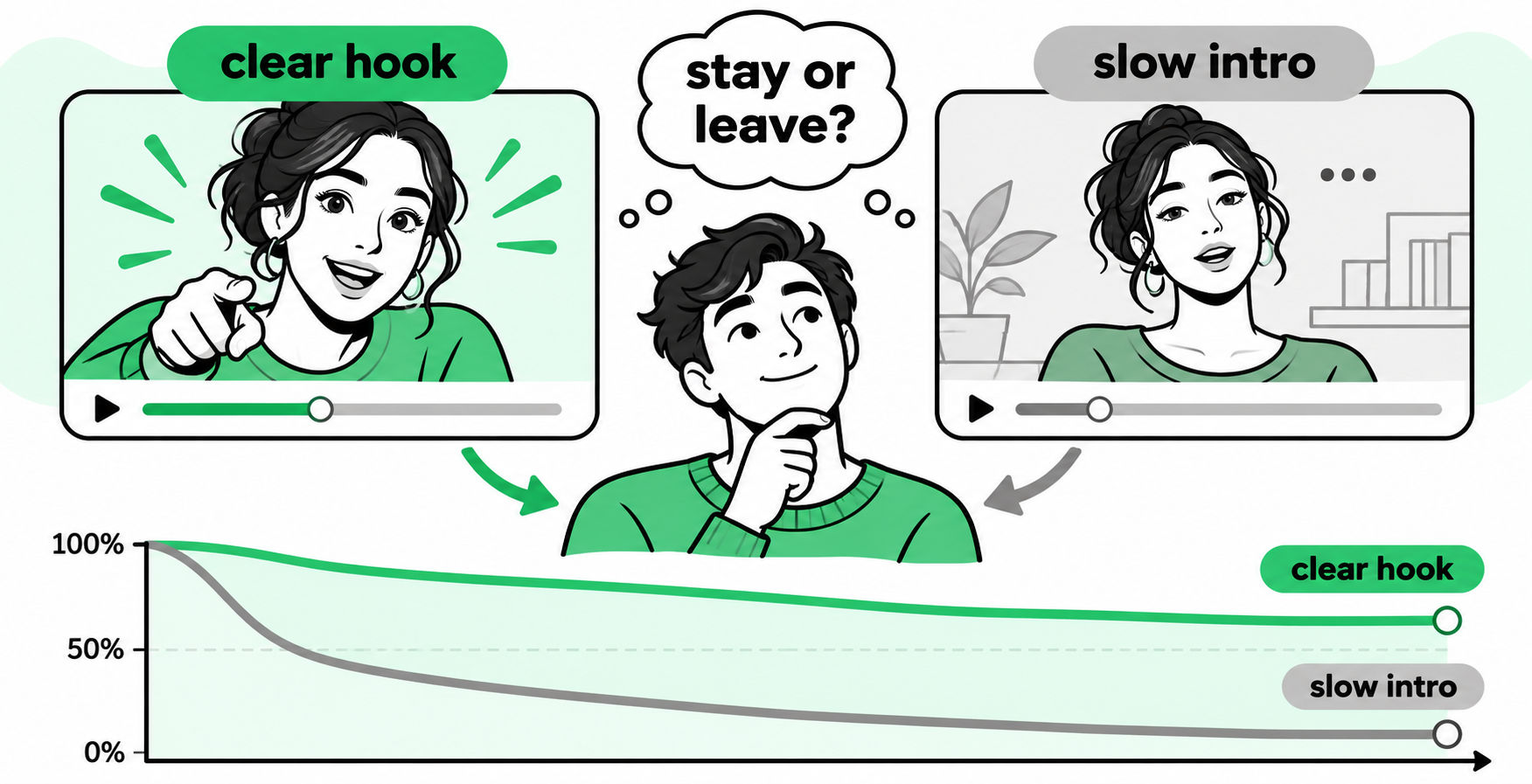
Of all the elements of a good video, this is the one that decides whether anyone sees the other six. The first few seconds of a video have exactly one job: give the viewer a reason to not leave. That’s it. Not “introduce the brand.” Not “say hello.” Not a logo animation. A reason to stay. This is the first, and arguably most important, item on any honest list of the elements of a good video.
YouTube’s own retention data makes this brutally clear — audience retention curves drop hardest and fastest in the opening seconds of almost every video that underperforms, and the industry benchmark reflects it: for long-form video in the 5–15 minute range, an average view duration around 40–55% of total runtime is considered solid, while most long-form videos settle closer to 25–35% once they run past 15–30 minutes. The videos sitting at the high end of those bands almost universally earn it in the first few seconds, not the last few minutes.
What a working hook actually does, mechanically — and what to study if you’re trying to learn how to make an engaging video from scratch:
- States the payoff before explaining the setup. “Here’s why your last three videos underperformed” beats “Hi everyone, today I want to talk about video performance.”
- Creates a specific, answerable question. Vague curiosity (“you won’t believe what happened”) decays fast. Specific curiosity (“why did this video get 4x the retention with half the budget”) holds.
- Shows, doesn’t just promises. A hook that opens on the actual result — the dashboard, the before/after, the number — earns more trust in two seconds than a verbal promise earns in ten.
The result? Viewers who were going to bounce at second three now have a reason to make it to second thirty. And every second of retention you buy in the hook compounds — the algorithm (on YouTube, Instagram, wherever) reads early retention as a quality signal and shows the video to more people because of it. A weak hook is the single fastest way to undo every other quality of a successful marketing video further down the timeline.
2. Preview the destination — then make them wait for it, a little
This is the second of the elements of a good video, and it’s the one that bridges the hook to the payoff. Here’s the tension every good video manages: you need to tell people where you’re going without giving the whole thing away in the first thirty seconds. This is the “preview the solution” move, and it’s the difference between a video that feels like a trailer and one that feels like a lecture with the ending spoiled.
The pattern that works: name the shape of the payoff — “there’s a specific reason the second half of this video always loses people, and it’s not the one you’d guess” — without handing over the mechanism yet. That’s an open loop. Open loops are why people keep scrolling through a thread, keep listening to a podcast segment, and keep watching a video past the part where they’d normally tab away.
Skip this step and you get one of two failure modes. Either the video front-loads everything (viewer gets the answer at second 20, has no reason to watch the other four minutes), or it never previews anything and just… starts explaining (viewer has no idea if this is going anywhere, so they leave to find out somewhere else). Both are retention killers. The preview is what buys you the middle of the video, and it’s one of the elements of a good video that’s easiest to skip by accident when you’re excited to just get to the answer.
3. The actual payoff needs proof, not just an opinion
This third item is where most lists of “what makes a great video” get vague, and it’s exactly where this one won’t. This is where most “content tips” videos and most brand videos quietly fall apart. They set up a hook, they preview a solution, and then the “solution” is just an opinion stated with confidence. “Storytelling is important.” “Consistency is key.” Sure. And?
A great video’s final act answers the hook with something concrete: a specific mechanism, a named example, a before/after, a number that would be hard to guess. Not “post more and you’ll grow” — but “channels that posted on a fixed weekly schedule for 90 days saw retention curves flatten out, because the algorithm had a consistent signal to learn from, versus channels that posted sporadically and kept resetting that signal every time.” One of those sentences is forgettable. The other one is quotable, which is the actual test — would someone screenshot this, or repeat it to a colleague? Proof, more than polish, is what separates the qualities of a successful marketing video from a video that merely looks like one.
This is also where most brands get nervous about length, and it’s worth saying directly, because it’s one of the most common questions people have about what makes a great video: length is not the enemy of retention — unearned length is. A 2,000-word article and an eight-minute video can both hold attention end to end, provided every section is paying rent. The moment a section stops adding new information, proof, or tension, that’s exactly where the drop-off graph will show it. So the real craft isn’t “keep it short.” It’s “never let the audience feel like they’re waiting for something to happen.”
4. Pacing: vary it, don’t just speed it up
A common but wrong fix for low retention is “make it faster” — jump cuts every half-second, zoom punches on every sentence, music that never breathes. That helps for about the first minute, and then it becomes its own kind of monotony, because sameness is sameness whether it’s slow or fast.
What actually holds attention is variation. A long explanatory sentence followed by a short, blunt one. A beat of quiet before a punchline. A section that slows down because the idea genuinely needs the room, followed immediately by one that moves fast because it doesn’t. Great editors and great writers do the same thing for the same reason: predictable rhythm is where attention goes to sleep. Pacing is, frankly, the most underrated of all the elements of a good video, because it’s invisible when it’s working and only gets noticed when it’s broken.
If you want a gut-check for this in your own footage or script, read it out loud. If every sentence feels the same length and the same energy, that’s the pacing problem, not an editing problem — no cutting pattern fixes a script that was flat before it hit the timeline. This is also a core part of how to make an engaging video from a script that hasn’t been shot yet: fix the rhythm on the page first, and your watch time will reflect it before you even open an editing tool.
5. A visual or structural reset when the topic shifts
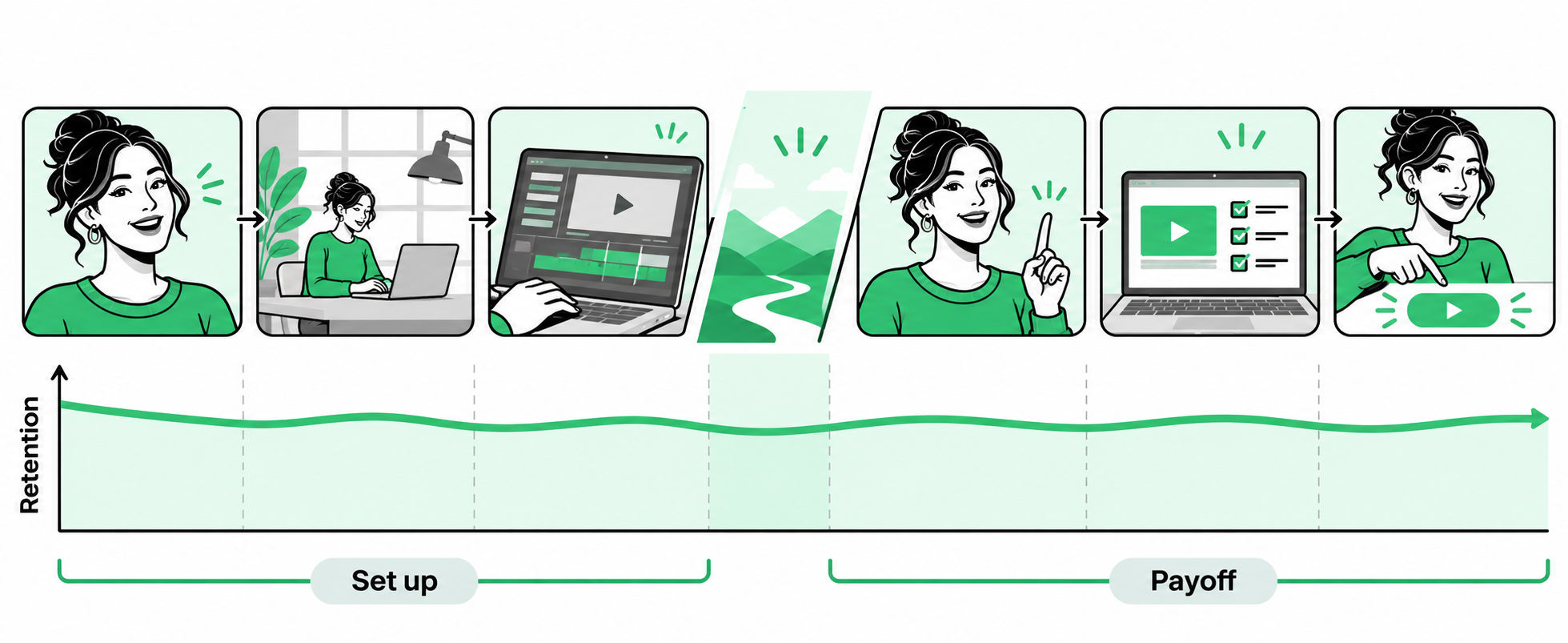
This is a quieter item on the list of elements of a good video, but skip it and the other six get noticeably less effective. Attention doesn’t fail because a video is “too long.” It fails because nothing changes. If the shot composition, the energy, the visual backdrop, and the talking pattern all stay identical for four straight minutes, the brain treats it as one long, undifferentiated block and starts tuning out — even if the information inside it is genuinely useful.
This is why the strongest long-form videos mark their section transitions visually, not just verbally. A new location. A graphic that appears. A cut to a different angle. A shift in music. These resets act like chapter breaks: they tell a half-distracted viewer’s brain, “new section, worth paying attention again,” and they give you a free retention bump at every section boundary instead of a slow bleed. It’s a small production choice, but it’s one of the clearer qualities of a successful marketing video when you compare retention graphs side by side.
6. The payoff has to match what the hook and thumbnail promised
Here’s one of the qualities of a successful marketing video you can test on your own catalog in five minutes: do your thumbnails and titles promise the same thing your videos actually deliver? This one sounds obvious and gets broken constantly. If your thumbnail says “the one video mistake costing you views” and the video spends ninety seconds on channel history before getting to the mistake, you’ve broken the contract — and broken contracts show up as retention cliffs at the exact point the viewer realizes they’ve been misled, even gently.
The fix isn’t to under-promise. It’s to deliver the promise fast and use the rest of the runtime to go deeper, not to delay. Answer the headline’s question in the first third. Spend the back two-thirds proving it, extending it, or handling the “but what if…” objections a sharp viewer would already be forming. That’s a video that earns a rewatch — because the value didn’t run out after the first answer. Keeping that promise intact is, arguably, what makes a great video rewatchable instead of just watchable once, and it’s also one of the clearest qualities of a successful marketing video you can spot just by comparing a channel’s rewatch rate across its catalog.
7. A single, specific call to action — not three vague ones
The end of a great video does one thing clearly instead of three things weakly. “Like, comment, subscribe, check the link in the description, and follow us on Instagram” is five asks competing for one decision, and the brain’s default response to five competing asks is to act on none of them.
The strongest videos end with one action that follows naturally from everything that came before it — if the video was about diagnosing a problem, the CTA is “here’s the tool/checklist/next video that fixes it,” not a generic subscribe reminder bolted onto the end. The CTA should feel like the next logical beat in the story, not a commercial break, and it’s the last of the elements of a good video that most people skip entirely when they’re rushing to publish. Get this right and you’ll often see it show up as a small bump in watch time on the very next video too, because viewers arrive already trusting that you’ll stick the landing.
Putting it together: the pattern behind every video that works
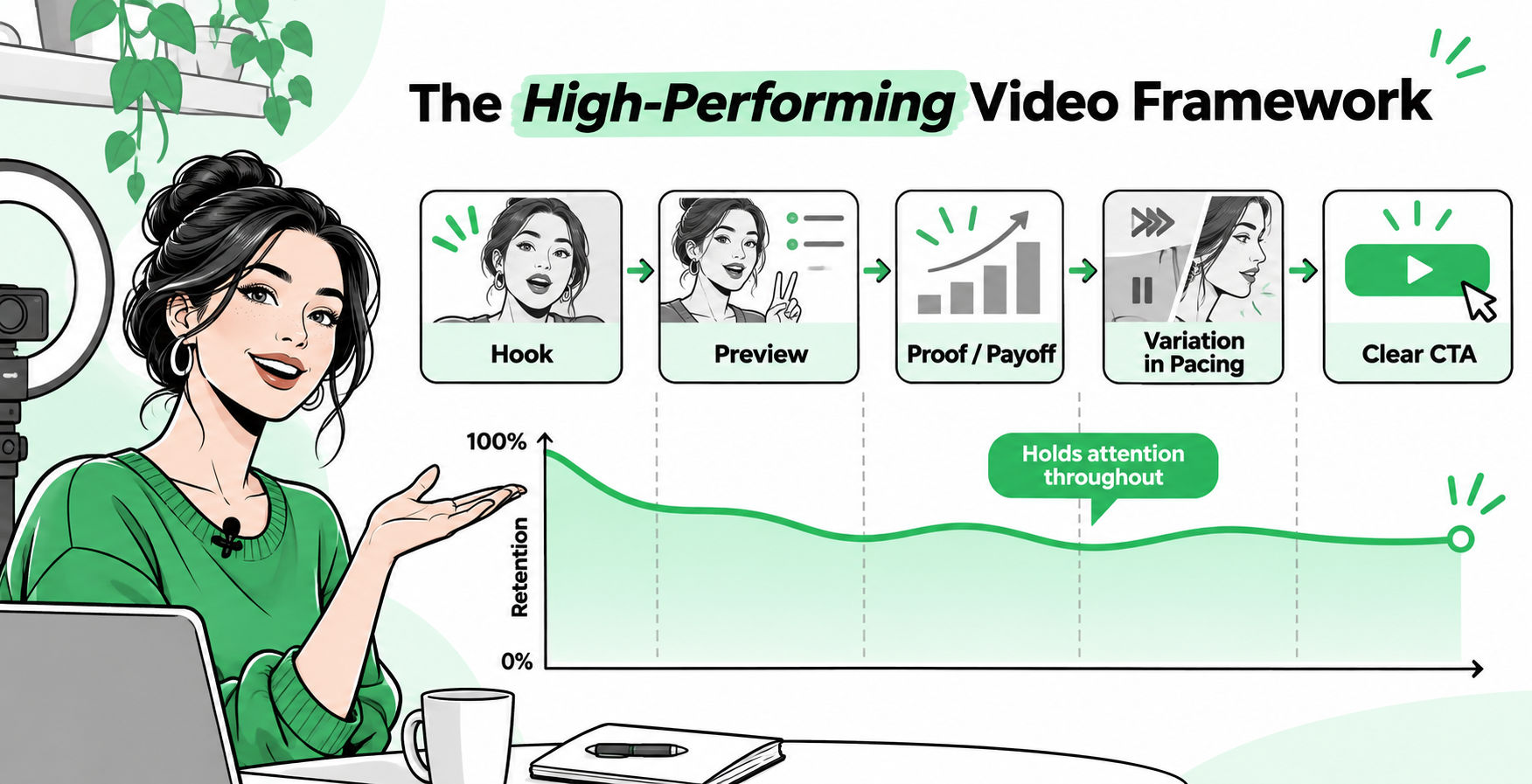
Strip away the specifics of format and platform, and almost every video that significantly outperforms its peers follows the same underlying shape: a hook that earns the next ten seconds, a preview that earns the middle, a payoff with real proof that earns the rewatch, pacing and visual variation that keeps the brain engaged throughout, and a single clear action at the end. That shape — more than any individual tactic — is what makes a great video instead of just a video. Everything else — lighting, music, graphics, how expensive the camera was — is in service of that shape, not a substitute for it.
The honest, slightly uncomfortable part of this is that you usually can’t tell which of your own videos nail the elements of a good video by watching them once yourself — you already know where the story goes, so you can’t feel where a cold viewer would drop off. That’s exactly what retention graphs, audience retention curves, watch time trends, and comparative analytics exist to catch: the specific second where attention breaks, repeated across enough videos that it stops being a guess about what makes a video good quality and starts being a pattern you can fix on purpose, before you ever hit publish on the next one.
That’s really the whole answer to what makes a great video, distilled: earn the first ten seconds, keep the middle honest, pay off the promise, and let your own watch time data tell you where you’re still losing people — because the elements of a good video are learnable, repeatable, and visible in the numbers long before they’re visible to your own eye.
FAQs
What is the single biggest factor in making a great video?
A hook that gives the viewer a specific reason to keep watching in the first few seconds. Production quality, music, and graphics all matter, but none of them can rescue a video that doesn’t earn the next ten seconds immediately — it’s consistently the first of the elements of a good video that people underrate.
Does video length affect how “great” a video is?
Not directly. Long-form videos can hold strong retention for ten-plus minutes if every section adds new information or proof; short videos can still lose viewers in the first few seconds if the hook is weak. The real driver of what makes a great video is whether each section earns its place, not the runtime itself.
What’s a good benchmark for audience retention on a video?
It varies by length and platform, so compare against your own similar videos rather than an absolute number. As a rough guide, 5–15 minute long-form videos often land around 40–55% average view duration, while videos over 15–30 minutes more typically sit around 25–35%.
Why do some videos with low production value outperform expensively shot ones?
Because retention is driven by structure and pacing — the hook, the pacing, the payoff — not by equipment. This is the real answer to what makes a video good quality: a simply shot video with a strong hook and a payoff worth the wait will consistently outperform a beautifully shot video that’s slow to get to the point.
How many calls to action should a video end with?
One. A single, specific action that follows naturally from the video’s content converts better than several competing asks, because it removes the decision friction that causes viewers to act on none of them — a small detail, but one of the qualities of a successful marketing video that compounds across every video you publish.
Leave a Reply