Your team is posting every day. You’ve got a content calendar, a Notion board, maybe even a freelancer cutting Reels on the side. And yet, three months in, you still can’t say which video actually moved a customer to buy.
Sound familiar? You’re not alone. Most brands aren’t struggling to make content — they’re struggling to make the right content, for the right person, at the right moment. That’s a focus problem, not an effort problem.
Here’s the thing: there’s a simple mental model marketers have been quietly using to fix exactly this, and it’s built on the number three. It’s called the 3-3-3 rule in marketing, and once you see it, you can’t unsee it in every good campaign you scroll past.
Let’s break it down — what it actually means, where it comes from, and exactly how to apply it if video is your main channel.
What Is the 3-3-3 Rule in Marketing?
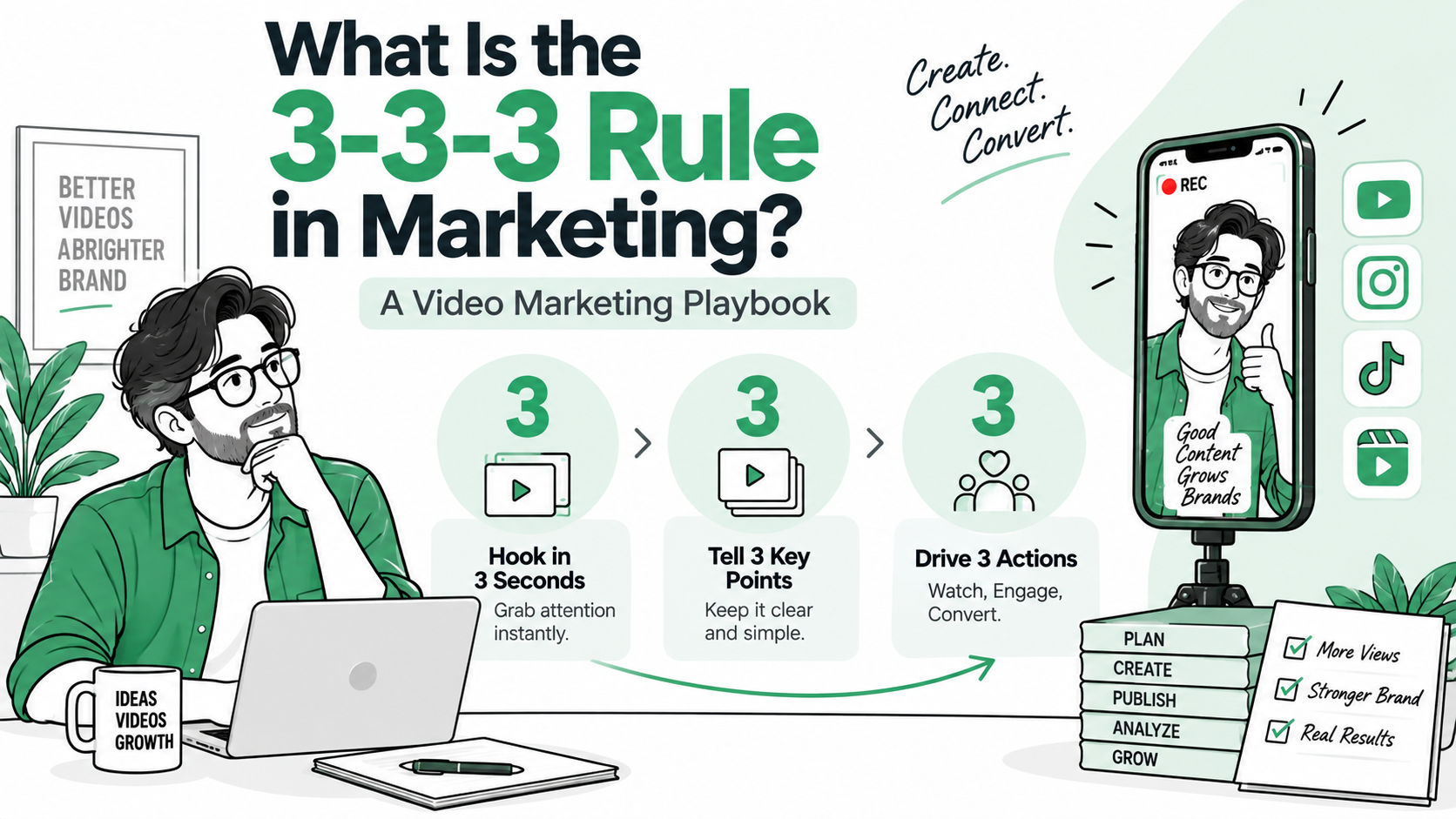
The 3-3-3 rule in marketing is a simplification framework that forces you to narrow your messaging down to three audience segments, three core benefits (or content types), and three distribution channels — instead of trying to be everything to everyone, everywhere, all at once.
It’s not a law of physics. It’s not one single, rigid formula either — you’ll find a few different flavors of it depending on who’s teaching it. But every version shares the same DNA: constrain your choices to three, and your marketing gets sharper.
Why three? Because three is the smallest number that still feels like a real decision. One option isn’t a strategy. Two feels like a coin flip. Three is enough to cover your bases without drowning your team in fifteen half-finished campaigns.
Why the 3-3-3 Rule Exists (And Why It Actually Works)
Marketing teams don’t fail because they lack ideas. They fail because they have too many.
Give a content team an open brief and you’ll get twelve content pillars, five target audiences, and a distribution plan that includes “maybe Pinterest?” Nothing gets the reps it needs to actually perform, because attention is split twelve ways instead of concentrated on three.
The 3-3-3 rule works because it borrows from a well-documented psychological principle: the rule of three. Humans remember things in threes. Three-act stories. Three-point speeches. “Blood, sweat, and tears.” Our brains are wired to process triads as complete, memorable units — anything more starts to blur.
So when you force your marketing into a 3-3-3 structure, you’re not being restrictive for the sake of it. You’re designing for how your audience’s brain actually retains information.
The Three Versions of the 3-3-3 Rule
Here’s where it gets interesting — and where a lot of the confusion around this term comes from. Depending on the context, “3-3-3” in marketing tends to show up in three distinct ways.
Version 1: Three Audiences, Three Messages, Three Channels
This is the strategic-planning version. You pick:
- Three audience segments — the specific groups you’re actually trying to reach, not “everyone who might buy”
- Three core messages or benefits — the outcomes you want each segment to associate with your brand
- Three distribution channels — where you’ll consistently show up (owned, earned, and paid media is a common split)
The goal is message discipline. If your VP of Marketing can’t repeat your three core benefits from memory, your customers definitely can’t either.
Version 2: The Creative Structure (3-Second Hook, 3 Proof Points, 3 CTAs)
This is the version that matters most if you live in ad creative or short-form video. It breaks a single piece of content into three parts:
- A three-second hook — because on YouTube Shorts, Reels, and TikTok, you’ve got about three seconds before someone’s thumb decides your fate
- Three proof points — the evidence, stats, or demo moments that back up your claim before the viewer’s attention drifts
- Three calls-to-action — repeated (not identical) prompts, because most viewers won’t act on the first ask
This version is essentially a creative brief in miniature. It’s also the one that translates most directly into video marketing, which we’ll get into shortly.
Version 3: Three Content Types, Three Channels, Three Journey Stages
The third flavor blends content strategy with the buyer’s journey:
- Three content types — typically educational, inspirational, and entertaining
- Three distribution channels — where each type actually gets seen
- Three buyer journey stages — awareness, consideration, and decision
You don’t need to pick just one version and marry it forever. Most mature marketing teams end up running a hybrid — Version 1 for quarterly planning, Version 2 for individual video briefs, Version 3 for mapping the content calendar. Here’s the kicker: they all point at the same underlying discipline — stop trying to do ten things badly, and do three things well.
How to Apply the 3-3-3 Rule to Video Marketing
Video is where the 3-3-3 rule earns its keep, because video is also where content sprawl gets the most expensive. A bad blog post costs you an afternoon. A bad video costs you a shoot day, an editor’s time, and a media budget behind it that never should have been spent.
So how do you actually apply the 3-3-3 rule for video content? Walk through it in four steps.
Step 1: Pick Your Three Audience Segments
Don’t default to “18-34, interested in fashion.” Get specific. If you’re a D2C skincare brand, your three might be: existing customers due for a repeat purchase, competitor switchers actively comparing products, and first-time researchers who just discovered the category exists. Each of these three needs a different video, not the same ad with a different thumbnail.
Step 2: Pick Your Three Video Formats
This is your content marketing rule of three in action. A workable spread for most brands looks like:
- Educational — a how-to, a myth-vs-fact breakdown, an explainer
- Social proof — a testimonial, a UGC-style unboxing, a before/after
- Entertaining/top-of-funnel — a trend-jack, a meme format, a founder-personality clip
Notice these map neatly onto the buyer journey stages: entertaining for awareness, educational for consideration, social proof for the final push toward acquisition.
Step 3: Build Every Video Around the 3-Second Hook + 3 Proof Points + 3 CTAs Structure
Whatever format you’re shooting, apply the creative-structure version underneath it. Open with a hook that states the problem or the surprise in the first three seconds — no logo intro, no slow zoom-in on your product, no “hey guys.” Follow it with three concrete proof points (a stat, a demo, a visual comparison). Close with a CTA, and if the video runs long enough, repeat a variation of it once more before the end card.
Step 4: Pick Your Three Distribution Touchpoints
For most brands running a video marketing strategy framework in 2026, this means YouTube (long-form + Shorts), Instagram (Reels + Stories), and one paid retargeting layer sitting behind both. Three is enough to build compounding reach without spreading your editing team across six platforms with six different aspect ratios.
A Worked Example
Picture a mid-market D2C nutrition brand. Their old approach: fifteen video ideas a month, posted wherever, tracked nowhere. Engagement was fine. Revenue impact? Nobody could say.
They ran the 3-3-3 rule instead. Three audiences: loyal repeat buyers, competitor switchers, and category newcomers. Three formats: a founder-led educational series, customer UGC testimonials, and a lighter trend-based Reels series. Three touchpoints: YouTube Shorts, Instagram Reels, and a retargeting layer for anyone who watched 50%+ of a video.
Within two content cycles, they weren’t making more videos — they were making a third of what they used to. But every video now had a clear job. That’s the actual payoff of the 3-3-3 rule: not volume, focus.
Common Mistakes When Using the 3-3-3 Rule
Treating it as a permanent cage. The 3-3-3 rule is a planning tool, not a religion. Revisit your three-three-three every quarter as your audience and channels evolve.
Picking three channels you can’t actually sustain. Three channels done consistently beats six channels done sporadically. If your team can’t realistically post three times a week per channel, cut the list further before you cut quality.
Skipping the hook. Teams love debating the CTA and forget the first three seconds are what determine whether anyone sees the CTA at all. Your video hook deserves as much iteration as your headline does.
Guessing which three are working. This is the one that quietly sinks most 3-3-3 rollouts. You pick three audiences, three formats, and three channels — but six weeks later, nobody’s actually measured which combination is driving comments, watch time, or category share versus competitors. You’re back to guessing, just with fewer variables.
How the 3-3-3 Rule Compares to Other Marketing Frameworks
You’ve probably also heard of the marketing rule of seven — the idea that a prospect needs seven touchpoints before they buy. That’s not a competing framework; it’s a companion one. The rule of seven tells you how many times to show up. The 3-3-3 rule tells you what to show up with, and where.
Same goes for the classic 80/20 rule, where 80% of your results come from 20% of your effort. The 3-3-3 rule is really the operational version of that idea for content teams — it forces you to identify the 20% (your three audiences, three formats, three channels) before you spend a single rupee producing anything.
None of these frameworks are mutually exclusive. Layer them: use the 3-3-3 rule to choose your focus, and the rule of seven to plan your frequency within each of those three channels.
Making the 3-3-3 Rule Actually Measurable
Here’s what nobody tells you about the 3-3-3 rule: picking your three is the easy part. Knowing whether your three are right is the hard part — and that’s a data problem, not a creativity problem.
This is exactly the gap Lumetrics was built to close. As a Video Intelligence Platform for YouTube and Instagram, Lumetrics runs ten AI modules that show you which of your three audience segments is actually engaging, which of your three formats is winning against your competitors, and — through its YouTube Keyword Rank module, a capability no other platform currently offers — where you actually rank for the searches your audience is typing before they ever hit play.
In other words, instead of reviewing your 3-3-3 rule once a quarter based on gut feel, you can see it update in real time: which hook is holding attention past three seconds, which proof point is driving saves and shares, and what script to brief next based on what’s already working for your category.
Lumetrics already powers this kind of decision-making for 48,000+ Chrome extension users, and enterprise teams can see it live against their own brand and three competitors in a 30-minute demo.
FAQs
What is the 3-3-3 rule in marketing?
The 3-3-3 rule in marketing is a framework for simplifying your strategy into three parts — commonly three audience segments, three core messages or content types, and three distribution channels. Some versions apply it to individual pieces of content instead, structuring a video or ad around a three-second hook, three proof points, and three calls-to-action.
Is the 3-3-3 rule the same for every brand?
No. The 3-3-3 rule is a flexible mental model, not a fixed formula. Different marketers apply the “three” differently depending on whether they’re planning a quarterly strategy, briefing a single video, or mapping content to the buyer journey. What stays constant is the discipline of narrowing focus to three.
How do I apply the 3-3-3 rule to video content specifically?
Pick three audience segments, three video formats (typically educational, social-proof, and entertaining), and three distribution touchpoints such as YouTube, Instagram, and a retargeting layer. Then structure each individual video with a three-second hook, three proof points, and three calls-to-action.
Why does the 3-3-3 rule work so well for social media video marketing?
Because attention on platforms like YouTube Shorts and Instagram Reels is scarce and the rule of three matches how the human brain naturally processes and remembers information. Narrowing your video marketing strategy framework to three of everything prevents your message from getting diluted across too many audiences, formats, or channels at once.
How do I know if my “three” are the right three?
You need visibility into performance data, not guesswork — watch time, engagement by segment, competitor benchmarking, and keyword rank data are what tell you whether your three audiences, formats, and channels are actually working. A video intelligence platform like Lumetrics is built specifically to surface that.
Ready to see which three are actually working for your brand? Book a 30-minute live demo — we’ll load your brand and three competitors and show you exactly where you rank.
Leave a Reply