
Here’s a hard truth about video hooks: they decide whether your video lives or dies.
Not your camera. Not the trending song. Not the hashtags you spent twenty minutes researching. The first three seconds.
Sound dramatic? Maybe. But here’s the thing: it’s true. If people scroll past your opening, nothing else in the video matters, because the platform has already learned that viewers don’t stick around for it.
The good news? Great video hooks aren’t magic. They follow patterns. And once you see those patterns, you’ll never write a weak opening again.
In this guide, I’m going to show you exactly how video hooks work. Here’s what you’ll learn:
- The two things every winning hook must deliver
- The four mistakes that quietly kill your views (and how to fix each one)
- The visual details that make or break a first frame
- 10 types of video hooks you can copy today
- A simple 5-step process for writing hooks fast
- Before-and-after hook makeovers you can steal
Sound good? Let’s dive right in.
What Is a Video Hook (and Why Does It Matter So Much)?
What is a video hook? A video hook is the first few seconds of your video: the opening line and the opening visual that decide whether a viewer keeps watching or swipes away. That’s it. It has one job, and that job is to convince a stranger to stay.
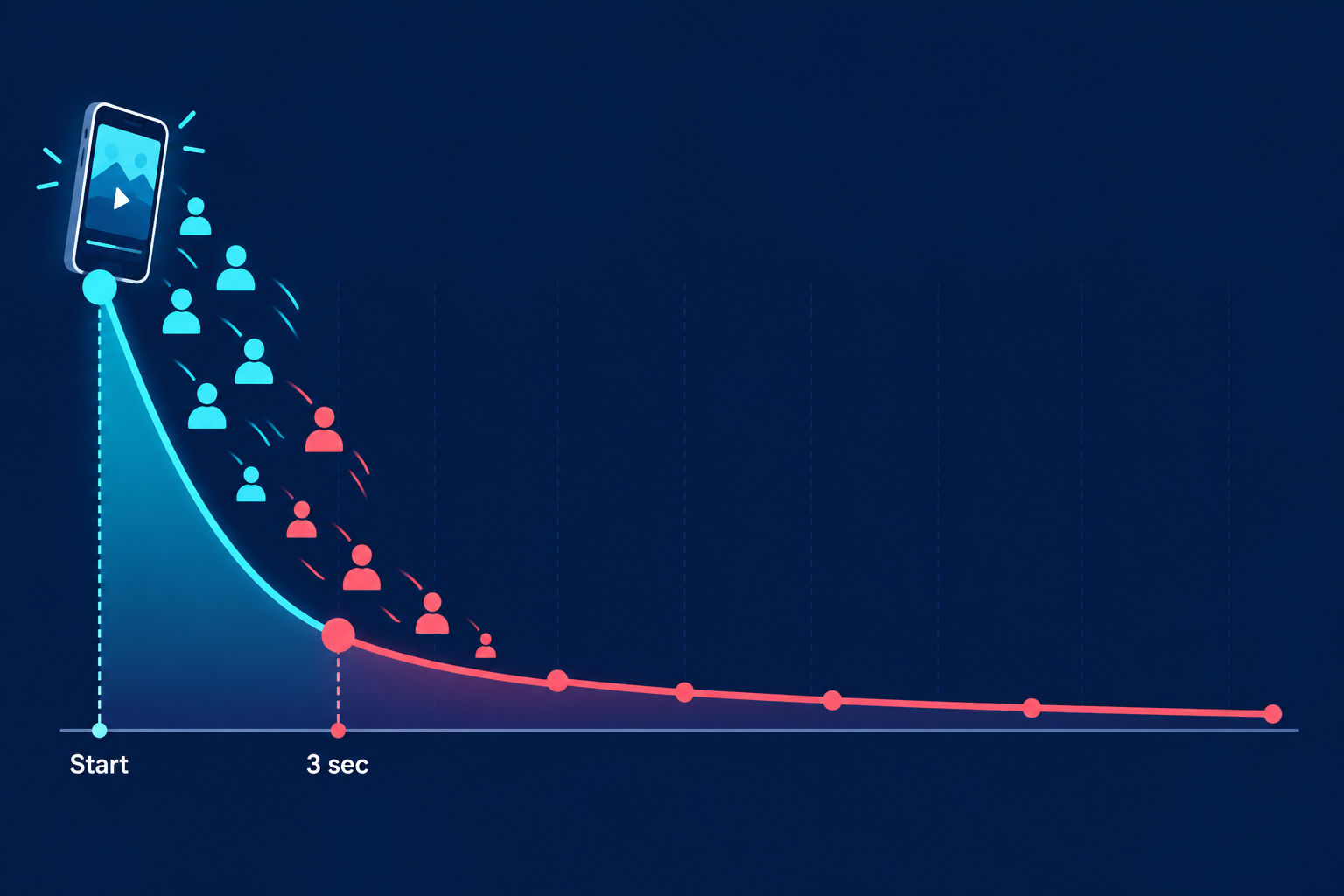
Why does that matter so much? Here’s the deal. Every platform tracks how many people stick around. Picture a graph that starts at 100% of viewers on second zero. Every second, a few more people leave. And the steepest drop happens right at the beginning.
So what happens if your best insight arrives at second ten? Let me explain. By then, most of your audience is already gone. They never see it. Worse, the platform notices too. A video that most people abandon quickly is a video it stops showing to new people.
Here’s the kicker: you can have the most valuable content on the internet, but if your opening is slow, vague, or confusing, it might as well not exist.
That’s why many creators treat hooks as the biggest lever in short-form video. Is it literally 80% of your results? Nobody can say for sure. But the point stands: fix your video hooks first, and everything else gets easier.
The Two Things Every Winning Video Hook Needs
Let me simplify this for you. A winning hook doesn’t need to be clever, loud, or shocking. It only needs to deliver two things:
- Topic clarity: The viewer instantly knows what the video is about.
- On-target curiosity: The viewer believes the video is for them and wants to know what happens next.
Simple, right? Best of all, this works in any niche. Clarity tells people what they’d be watching. Curiosity gives them a reason to keep going. Miss one, and the scroll continues.
Here’s a quick test. Read only your first line, with nothing else around it. Can a stranger tell what the video is about? Do they care? If the answer to either question is no, your video hook needs work.
So how do you make sure your hook delivers both, every single time? By avoiding four specific mistakes. Let’s go through them one by one. Ready?
4 Video Hook Mistakes That Are Killing Your Views
Nearly every weak hook falls into at least one of four traps: delay, confusion, irrelevance, or disinterest. Fix all four, and your video hooks get dramatically better.
Video Hook Mistake #1: Delay
What is delay? Delay means you wait too long to tell people what the video is about. The topic shows up in line three, four, or five, after a bunch of throat-clearing that nobody asked for.
Here’s an example. Imagine opening with: “You won’t believe what I just found on Instagram. Seriously, it’s wild.” Sounds intriguing, right? But here’s the problem: you haven’t told me anything. A wild discovery could be about literally anything. Skincare. Crypto. Cats. As a viewer, I can’t decide if it’s for me, so I do what any sensible human does. I swipe.
Now compare that with: “Here are three Instagram Story stickers that get more replies from your followers.” In one sentence, I know the topic, the value, and who it’s for.
The fix? Speed to value. Look at your script. Find the first line that names the topic. Then delete everything above it. Seriously. Cut the greeting, the warm-up, and the backstory. The topic goes in the first one to two seconds.
Now, a quick warning. Vague, open-ended hooks can occasionally work when the creator’s face, emotion, or on-screen text carries the moment. But then the spoken words add nothing, and that’s a shaky foundation to build on.
Video Hook Mistake #2: Confusion
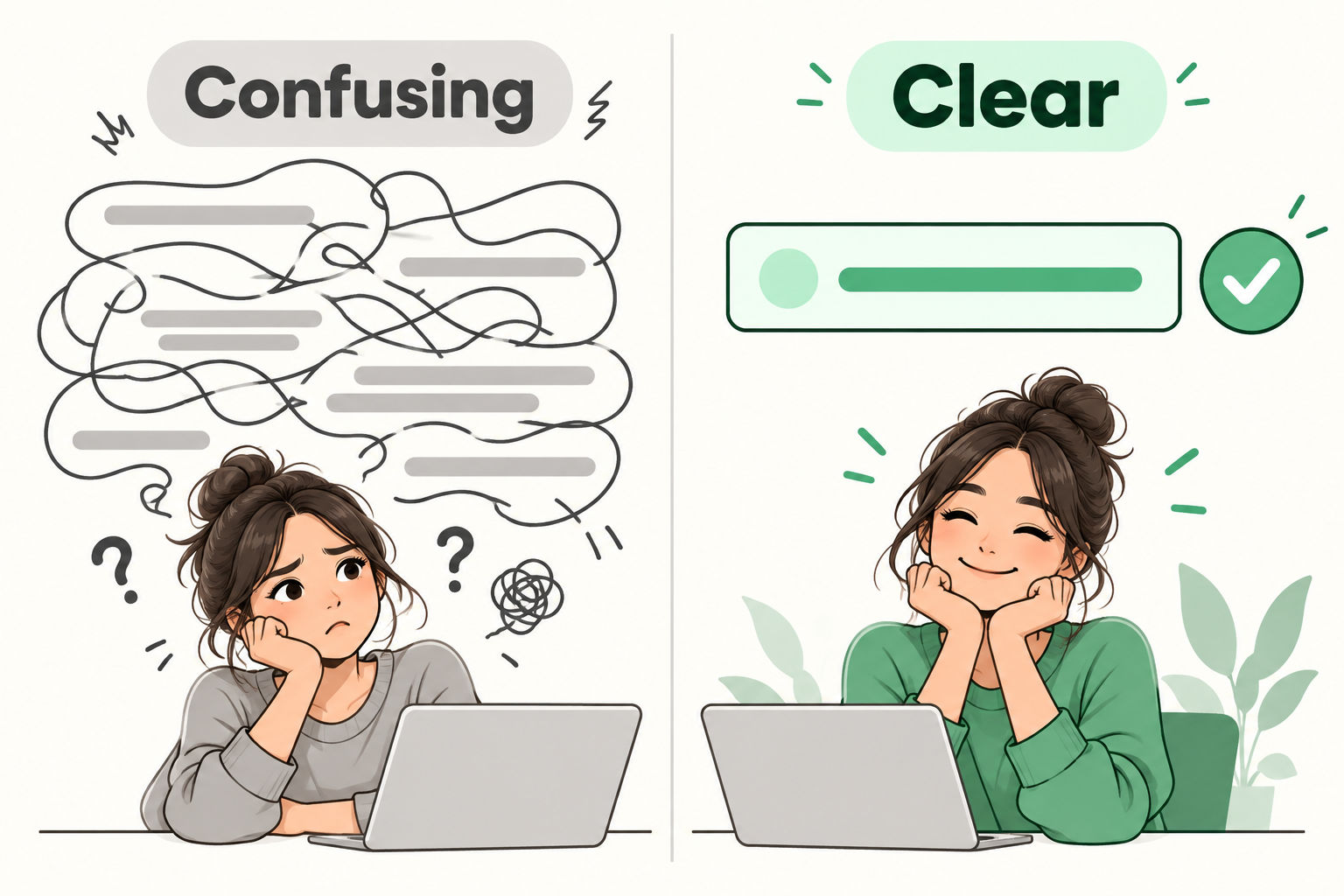
Delay fixed? Great. Now let’s talk about confusion. This one happens when your opening is fast but hard to understand. The sentence is twisty, the words are fancy, and the viewer has to work to figure out what you mean.
Here’s what I mean, starting with a confusing example: “The kind of Instagram growth that’s hardest to earn is what brands miss when Reels get skipped.” Wait, what? Now read this: “Most brands stall on Instagram because they skip Reels.” Same idea. Half the words. Twice the clarity.
Why does this matter? Here’s why: viewers decide in a heartbeat. If they only understand half of your words, they can’t tell whether the video is for them. And when in doubt, they leave.
So how do you write clearer video hooks?
- Use fewer words. Say it in the shortest way that still can’t be misunderstood.
- Use simple words. Aim for a sixth-grade reading level.
- Use active voice. “The dog jumped” beats “the jump of the dog.”
- Proof it in isolation. Read just the hook. Could it be interpreted two different ways? If so, rewrite it until there’s only one meaning.
Pro tip: paste your hook into an AI writing assistant and ask it to rewrite the line at a sixth-grade reading level without changing the meaning. It’s a fast way to spot clunky phrasing.
Video Hook Mistake #3: Irrelevance
Now your hook is fast and clear. But there’s still a problem: does the viewer think it’s for them? That’s relevance, and it’s where lots of creators slip.
Here’s the most common cause: talking about yourself. Consider this opening: “I’ve struggled with low reach for two years.” It might be true. But the viewer instantly wonders, “Do I even have the same problem as you?” That tiny doubt is enough to make them scroll.
The fix is almost embarrassingly easy. Swap “I” and “me” for “you” and “your.” Instead of “I struggled with low reach,” try: “If your Reels are stuck under 500 views, try this.” Now the viewer sees themselves in the video. The result? More people stay.
There’s a second trick, too: frame your hook around a pain point. Compare these two:
- “Here are three trends in social media marketing.”
- “If your Instagram followers aren’t buying, fix these three things.”
The first is nice to have. The second solves a problem the viewer already feels. Guess which one gets watched?
That’s the difference between a hook that informs and a hook that actually hooks.
Video Hook Mistake #4: Disinterest
Last one. And it’s the mistake most creators obsess over. Your hook is quick, clear, and relevant. But it still doesn’t make people curious enough to stay.
The solution is something called a curiosity loop. Here’s how it works: the viewer sees something, asks a question in their mind, gets a little more context, and immediately has a new question. Each answer opens the next question. Your job in the first few seconds is to open the first loop.
Okay, but how do you open a loop every time, no matter your niche? Here’s how: with contrast.
Contrast is the gap between what your viewer already believes and a different possibility you’re offering. Picture two points. Point A is the common belief: “You need to post every day to grow.” Point B is your alternative: “Here’s why fewer, better posts can win.” The distance between A and B is what makes people lean in. Pretty cool, right?
There are two ways to use it:
- Stated contrast: You say both sides out loud. “Most people fix low reach by posting more, but the smarter fix is a better first line.”
- Implied contrast: You state only the alternative, because your audience already knows the baseline. “If you want people to watch longer, rewrite your first line before you touch anything else.”
Tactically, put topic clarity in line one and set up the contrast in the next one or two lines. That’s why hooks are often two or three lines, not one punchy sentence. If you can do both in a single line, brilliant. Save it. You’ll reuse it again and again.
Don’t Forget the Visual Side of Your Video Hooks
So far, we’ve talked about words. But a video hook is also what people see. And plenty of great scripts get wrecked by a messy first frame. Best of all, most of these fixes take just a few minutes.
Respect the Safe Zone
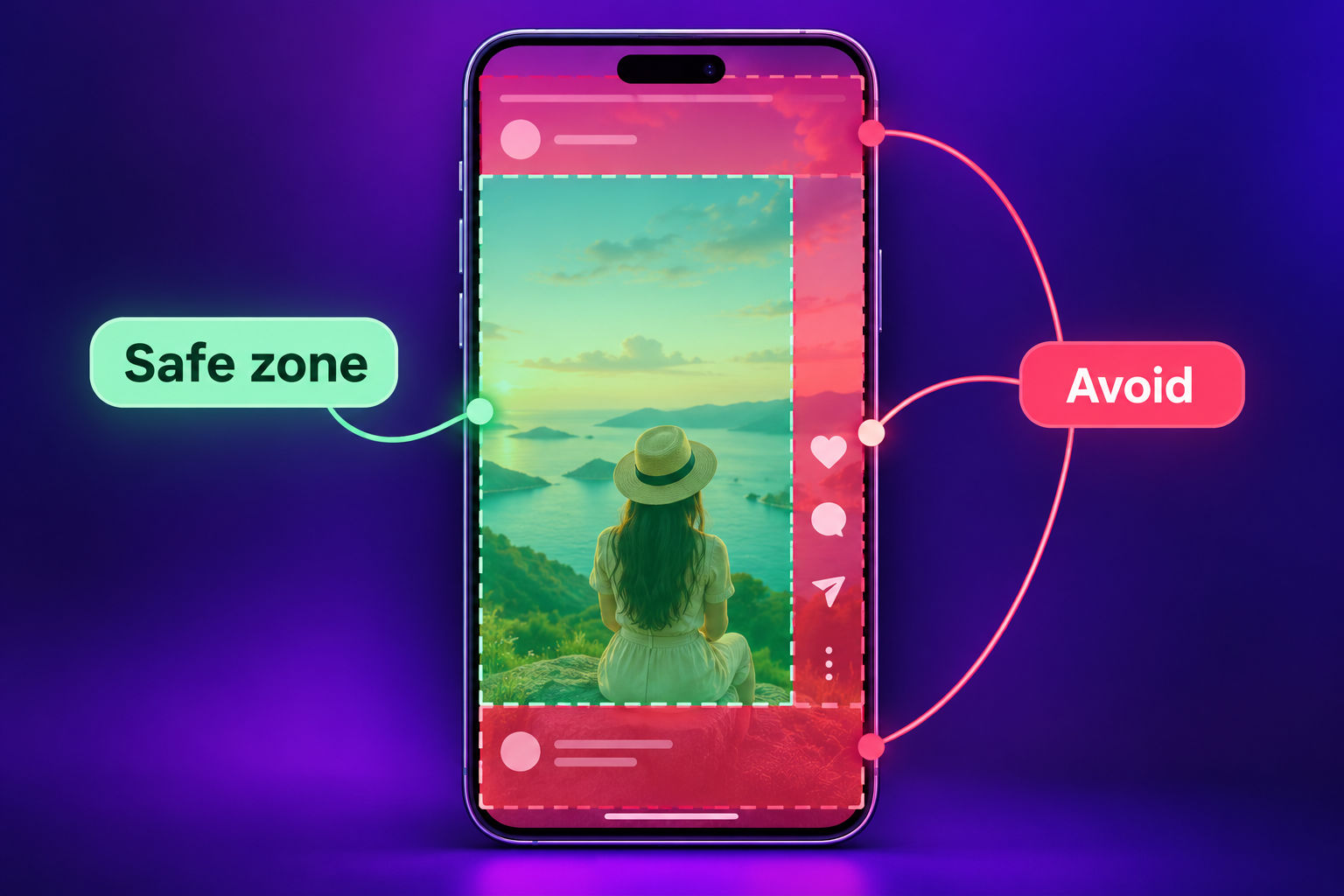
Every platform covers parts of the screen with buttons, captions, and usernames. Text that sits under those elements becomes unreadable. Keep your hook text inside the safe zone, and keep it a little smaller than you think you need.
Declutter the First Frame
Is there one clear focal point? Or is the frame a mash of props, text, and background? A cluttered opening makes it harder for a viewer’s brain to say, “Hmm, that’s interesting.” Simplify. One subject. One message.
Add Context With On-Screen Text
Your spoken line might be strong. But if the frame shows a person in a kitchen saying something with no context, viewers are lost. Put a short text hook at the top that names the topic, then let your spoken line add the curiosity.
Keep the Loop Open
Here’s a sneaky trick. If your first frame shows the answer, such as the finished result, viewers solve the mystery themselves and leave. Instead, blur or hide the reveal and let the text raise the question. Keep the loop open until the payoff.
Make Your Profile Match Your Hooks
Most people who find you through Reels will check your profile next. If your grid is full of lovely photos with no clear message, while your Reels open with vague hooks, the mismatch kills trust. Give every format a clear reason to follow you.
Choose High-Contrast Text Colors
White text on a dark bar or a bold yellow can pop, while other colors feel cheap or hard to read. Test two or three options and pick the one that reads instantly on a phone screen.
10 Types of Video Hooks You Can Copy Today
Ready for the fun part? Here are ten proven types of video hooks. Mix them, match them, and swap in your own topic.
1. The Teaser Hook
What it is: A quick taste of what’s coming, without spoiling it. It creates suspense and leaves viewers wanting more.
Example: “By the end of this video, you’ll know the one edit that makes Reels feel twice as fast.”
2. The Question Hook
What it is: An opening question that gets people thinking. The best ones name a problem your viewer already has.
Example: “Ever posted a Reel you loved, only to watch it flop?”
3. The Statistic Hook
What it is: A surprising number that makes people stop and pay attention. Always use a real, sourced figure. Never invent one.
Example: “[Your sourced number] of viewers leave before the five-second mark. Here’s how to keep them.”
4. The Emotional Hook
What it is: A line that speaks to a feeling, whether that’s frustration, hope, pride, or relief.
Example: “Posting for months and hearing nothing back is exhausting. Here’s what helps.”
5. The Personal Story Hook
What it is: A short piece of your own experience that helps viewers relate and feel connected to you.
Example: “I almost quit posting last year. Then I changed one thing about my first line.”
6. The Humorous Hook
What it is: A funny line that lightens the mood and makes people smile before they scroll.
Example: “My relationship with the algorithm is complicated. It ignores me, and I keep coming back.”
7. The Scenic (Visual) Hook
What it is: A breathtaking or eye-catching visual that grabs attention before a single word is spoken.
Example: A slow reveal of a mountain sunrise, with the text “How I film travel Reels with just a phone.”
8. The Testimonial Hook
What it is: A quote from a real customer or expert that adds credibility right away. Only use real testimonials, with permission.
Example: “A customer told me this tiny tweak saved her hours every week. Here’s the tweak.”
9. The Action Hook
What it is: You start mid-action, showing a product or process in use so viewers see the value immediately.
Example: Open on the finished product already in motion, with the text “Watch this get built in 10 seconds.”
10. The Surprise Hook
What it is: Something unexpected that breaks a viewer’s pattern and makes them stop scrolling.
Example: “This looks like a photo. It’s actually a video.”
So which one should you use? Start with the type that best matches your video’s promise, then run it through the four-mistakes check from earlier. If it’s clear, relevant, and curious, you’re good.

How to Write Video Hooks in 5 Steps
Knowing the types is one thing. Writing them quickly is another. Here’s a simple process you can follow every time.
Step 1: Build a Swipe File of Proven Video Hooks
Here’s a secret most beginners skip: study what already works. Why? Because you’ll learn faster from a hundred real examples than from any theory. Find videos in your format and niche that clearly performed well, then write down the first line of each one. Not to copy word for word, but to learn the patterns. Every craft is learned by studying the masters, and video hooks are no different.
A quick tip: match by format first and niche second. A talking-head hook works differently from a montage hook. But a fitness hook can teach a business creator plenty if both are talking-head videos.
Step 2: Decode Why the Hook Worked
Now for the detective work. Ask yourself: what made viewers stay? Look for emotional keywords. Words like “broke,” “burned out,” or “secret” hit differently than bland words like “improve” or “better.” Notice the numbers, the tension, and the target audience. Sometimes the whole difference between a hook that flops and one that flies is one or two words.
Step 3: Swap Your Topic Into Proven Video Hook Formats
Take a hook format and inject your idea. Here are fill-in-the-blank templates to get you started:
- Here’s how to [result] without [common pain].
- If you’re [audience] struggling with [problem], try this.
- Most people [common belief]. But [surprising alternative].
- [Number] mistakes that are killing your [goal].
- Stop [common action]. Do this instead.
- The easiest way to [result] in [time frame].
For example: “The easiest way to get more saves on Instagram this week.” Boom. Done.
Step 4: Run the Hook Checklist
- Clarity: Is this the shortest, clearest way to say it?
- Specificity: Can you add a number, a keyword, or a concrete detail?
- Audience: Who is this for, and does the wording call them out?
- Novelty: Does anything make it stand out from the usual openings? Think of a purple cow in a field of brown ones.
- Alignment: Does the rest of the video deliver on what the hook promises?
- Visual: Is the first frame clean, and is the text inside the safe zone?
Step 5: Read It Aloud and Test It
Say your hook out loud five times. Does it flow? Does it sound like something a real person would say? If it feels clunky, rewrite it. Then publish, watch your retention data, and learn. Over time, the patterns get obvious.
Video Hook Makeovers: Weak vs Strong
Want to see it in action? Let me show you. Here are five quick before-and-after examples.
| Weak hook | What’s wrong | Stronger hook |
|---|---|---|
| “Guys, you won’t believe this.” | Delay: no context on the topic | “Here are three free tools that make Reels editing twice as fast.” |
| “I’ve been struggling with my Instagram for years.” | Irrelevance: it’s about me, not you | “If your Instagram has been stuck for months, try this.” |
| “The reach that’s hardest to get comes from consistency in posting Reels.” | Confusion: twisty and hard to parse | “Consistent Reels are the easiest way to reach new people.” |
| “Here are some trends in marketing.” | Disinterest: no pain point, no curiosity | “If your posts aren’t getting sales, fix these three things.” |
| “Today I want to talk about hooks.” | Delay and no curiosity | “Your first three seconds decide everything. Here’s how to fix them.” |
Notice the pattern? That’s not a coincidence. Every stronger hook is shorter, clearer, and speaks directly to “you.”
Do Video Hooks Matter More Than Everything Else?
So are hooks really more important than music, hashtags, and posting time? Let’s be careful here.
Video hooks are a huge lever. If people leave in the first seconds, no amount of hashtag research will save the video. And chasing the “perfect posting time” won’t beat a stronger opening.
But hooks aren’t the whole story. Audio quality, lighting, and real value still matter. And a great hook attached to a weak video is just clickbait. If the hook promises one thing and the video delivers another, viewers feel tricked, and they leave anyway.
Bottom line: think of your hook as the door and the rest of your video as the room. A beautiful room behind a hidden door helps no one. But a great door leading to an empty room doesn’t either.
Be Patient: Video Hooks Get Better With Reps
Here’s another thing nobody tells you. Your first few weeks of posting might feel discouraging. Views might sit flat. That’s normal. You’re learning hooks, editing, lighting, scripting, and camera confidence all at once. For many creators, things start to click after a couple of months of steady posting. The ones who quit during the plateau never find out. So treat every video as practice, and keep a rhythm you can actually sustain.
Track What Happens in the First Seconds
Check your retention data after each post. Where does the audience drop off? If it’s in the first few seconds, your video hooks need work. If it’s later, the middle of the video needs work. Keep a simple log with the hook type, the first line, and the results. Within a few weeks, you’ll know which hooks your audience loves.

Your Quick Video Hooks Checklist
Before you hit publish, run through this list:
- Does the topic appear in the first one to two seconds?
- Is the wording simple enough for a sixth grader?
- Does it say “you” and “your” instead of “I” and “my”?
- Is it built around a pain point or a clear benefit?
- Does it open a curiosity loop with contrast?
- Is the first frame clean, with text in the safe zone?
- Does the rest of the video deliver on the promise?
- Have you read it aloud at least once?
FAQs About Video Hooks
What is a video hook?
A video hook is the opening line and visual of your video, usually the first three seconds, designed to make viewers stop scrolling and keep watching.
How long should a video hook be?
Most video hooks are one to three short lines and last about three to five seconds. Put the topic in the first line, then add curiosity in the next one or two.
What is the best type of video hook?
There isn’t one best type. Question, teaser, and pain-point hooks work well for tutorials, while story and emotional hooks work well for personal content. Match the type to your video’s promise.
Do video hooks work on Instagram Reels, TikTok, and YouTube Shorts?
Yes. All three platforms reward videos that people keep watching, so the same principles of clarity, relevance, and curiosity apply everywhere.
Can I reuse the same hook format?
Yes. Proven formats can be reused with a fresh topic each time. Just avoid repeating the exact same words, or your audience will notice.
How do I write a hook if I don’t want to be on camera?
Lean on strong on-screen text, a clean first frame, and a voiceover. A clear text hook at the top can do the same job as a spoken line.
Why do my videos get views but poor watch time?
Usually the hook attracts people, but the rest of the video doesn’t deliver on its promise. Make sure the video pays off what the hook sets up, and check where viewers drop off.
How many hooks should I test?
Write five to ten video hooks for every video, then pick the clearest and most relevant. Over time, keep a log of what works best for your audience.
Final Thoughts: Start Writing Better Video Hooks Today
Let’s recap. Video hooks have one job: get a stranger to stay. To do that, they need topic clarity and on-target curiosity. Avoid the four big mistakes (delay, confusion, irrelevance, and disinterest), keep your first frame clean, and borrow from the ten hook types above.
Here’s your action step. Take your next video idea and write five different video hooks for it. Read them aloud. Pick the clearest one. Then publish it, check your retention, and learn.
Do that for a few weeks, and you’ll be amazed how much your views change. Now go write a hook.
Leave a Reply